Eldar
This page is a work in progress!
Special Rules
Eldar Leadership
All Eldar ships add + 1 to the Leadership score generated on the Leadership table on pg. [???] of the Remastered Rulebook, giving them a Leadership value between 7 and 10.
Eldar Attack Rating
An Eldar fleet containing any Craftworld Eldar vessels has an attack (or initiative) rating of 3.
An Eldar Corsair fleet containing no Craftworld Eldar vessels has an attack (or initiative) rating of 4.
Craftworld & Corsair Vessels
Outright alliance between fleets acting on the will of a Craftworld’s Seers and the more volatile, self-serving Eldar Corsairs is relatively rare, but certainly not unknown. It does, however, usually only occur when a knowledgeable leader of great influence is present, able to both satisfy the careful measured desires of the Seers yet at the same time prove his might to the more aggressive pirates. Such leaders, like the legendary Yriel, are rare, but the fleets they command are invariably powerful.
Ordinarily, Craftworld Eldar fleets cannot use the Reserves rules to pick ships from a Corsair fleet (nor vice versa). To use a mixed Craftworld and Corsair fleet, you must first choose to use ONE particular Eldar fleet list. In place of that fleet’s normal Fleet Commander option, you must then choose an Eldar Hero. The presence of an Eldar Hero then entitles your fleet to take ships from the ‘other’ Eldar list (i.e. reserve Corsair ships if your fleet is a Craftworld Eldar fleet, reserve Craftworld Eldar ships if your fleet is made up of Corsairs).
Eldar Ship Movement
The movement rules below replace the normal movement rules for Eldar ships. Assume anything not modified below applies normally to the Eldar. Eldar ships move in their movement phase and in the ordnance phase of their own turn. Note that they do not move in the ordnance phase of the enemy's turn.
Before an Eldar ship moves, it may turn to face any direction. It always turns before it moves and then remains facing in that direction until the start of its next move.
Work out the speed an Eldar ship can move at after it has turned. Its speed depends on its facing towards the sunward table edge. All Eldar ships have three speeds (for example, 10/20/30). The first is used if the sunward table edge is in the Eldar ship's front fire arc; the second is used if the sunward table edge is in its rear fire arc; and the third is used if the sunward table edge is in its left or right fire arcs. If the sunward table edge lies on the line between two fire arcs, the Eldar player may choose which he uses.
An easy way to determine a ships facing in relation to the sunward edge is to place a bearing compass over the ship and draw the shortest possible line from the ships stem to the sunward edge. The arc this line passes through is the sunward facing, or sunward arc. Eldar ships have no minimum move distances. They move from zero up to the maximum distance allowed by the direction of the sun. After their initial turn they travel in a straight line and may not make additional turns as they move. If under Lock-On special orders, Eldar ships cannot turn for BOTH their movement phases.
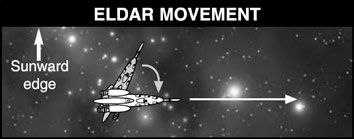
Craftworld and Corsair Eldar vessels follow similar movement rules. Here a Hellebore class Corsair escort has Speed 10/20/30. At the start of its move, it turns in the direction shown, so that the sunward table edge is in its left fire arc. This gives it a speed of 30 cm. It can then move up to 30 cm straight ahead.
As noted above, the Eldar move twice in each of their turns. The second move is made in the ordnance phase after any ordnance is moved, but apart from this all the rules described for Eldar movement will apply.
Celestial Phenomena
Eldar ships can make a leadership check to ignore all effects of celestial phenomena such as gas clouds, solar flares, etc. Escorts may re-roll this result for free.
If an Eldar vessel passes its leadership check during a solar flare, it will take no damage but turn directly away from the sun edge and move 2D6 cm.
This ability only applies to celestial phenomena, not explosions from catastrophic damage, nova cannon, etc. It also does not affect negative leadership modifiers caused by radiation bursts. Leadership checks against asteroid fields are unchanged from those for other fleets.
Blast Markers and Gravity Wells
Eldar are affected by Blast markers in the same way as other ships without shields – they will take a point of damage on a D6 roll of 6 and reduce their speed by 5 cm that turn. Eldar have to make a test after each of their two movements in which they encounter blast markers . Gravity wells allow Eldar to curve their normally straight line move around the planet and so the ship may make a free turn towards the planet at the end of its move (since it can turn in any direction at the start, there is no additional benefit at the start of its move).
Special Orders
Due to their unique method of movement, the Eldar may not use the following special orders: All Ahead Full, Burn Retros and Come To New Heading. Note: because Eldar ships cannot use All Ahead Full special orders, they also may not ram.
If under Lock-On special orders, Eldar ships cannot turn for BOTH their movement phases. When locked-on, Eldar Pulsars re-roll EACH miss until either up to three hits is scored or a miss is missed again.
Holofields
Against attacks that use the Gunnery table, the holofields cause one column shift to the right, in addition to any other column shifts for range or Blast markers. Against any other form of attack (ALL strength-based weapons, Nova Cannon shots, any ordnance attacks and any kind of hit and run attacks, ramming and boarding), roll to hit an Eldar ship as normal, but the Eldar player may then make a saving roll for his holofields:
| D6 ROLL | RESULT |
|---|---|
| 1 | Hit! Score a hit on the Eldar ship. |
| 2-6 | Missed! Place a Blast marker in contact with the ship. |
Note that holofields do not negate hits or effects from moving through blast markers, area effects, exploding ships and celestial phenomena. They do, however, work against ordnance hits, hit-and-run raids, boarding actions, teleport attacks, ramming or nova cannon.
Against ramming and boarding, they save once against the ramming or boarding attempt, NOT against any damage suffered if this save fails.
They do NOT protect against hits caused by celestial phenomena nor any area effects such as Warp Drive implosions, Necron Nightmare Fields, Chaos Marks of Slaanesh, etc.
Holofields save against the shell hit of the nova cannon, meaning both a direct hit from a Nova Cannon where the hole is over the base as well as against the single automatic hit for coming in base contact with the blast template.
If this save is successful the effect of the Nova Cannon is negated, and a Blast Marker is placed normally for the save.
If the vessel fails to save, it must immediately take as many hits as the damage roll allocates. Holofield saves can't be taken against the subsequent damage rolls, but if it braced beforehand, this works normally.
Eldar must determine if they wish to brace against damage they may face BEFORE rolling their holofield save. This includes damage from scatter weapons such as Nova Cannon fire.
When protecting against damage (except against weapons that use the gunnery table), Holofields roll its save once against each successful attack, whether it be from lance fire, ordnance hits, etc. In other words, its rolls once against a ramming attack, once against each Nova Cannon shot, and once against each hit imparted by ordnance attacks, Hit and Run attacks, etc.
Eldar Weapons
Eldar ships carry three main weapon systems which are described below.
Pulsar Lance
Pulsar lances fire volleys of high energy laser bolts. These count as lance shots, and hit on a 4+ no matter what the target's armour. However, if a pulsar lance shot hits, then you may roll to hit again and you may keep on rolling to hit until you miss or the lance has scored a total of 3 hits.
Shadow Lance
Although larger capital ships employ the powerful Pulsar lance, the vast energy arrays required to power such weaponry are far too large to be mounted on the necessarily swift and nimble Shadowhunters. Instead, smaller Eldar vessels are armed with the Shadow lance – a less powerful version of the same Eldar laser technology. Shadow lances count as typical lances in every respect (ie. no multiple shots).
Weapons Batteries
Eldar weapons batteries are short-ranged weapons that unleash a torrent of fire. They employ sophisticated targeting systems which make them very accurate even at extreme angles of attack. To represent their accuracy, Eldar weapons batteries count all targets as 'closing' on the Gunnery table, no matter what the target's actual aspect is (defences are still targeted as such). This aside, all the normal rules apply.
Ordnance
For various lore reasons described below, all Eldar Ordnance can only be hit by defensive turrets on a roll of 6, rather than on a roll of 4, 5, or 6 as is normally the case. This includes attack craft, any torpedo types, assault boats and orbital mines.
When orbital mines are used, they completely replace all other attack craft used by the launching carrier, with one orbital mine per launch bay.
As Eldar vessels do not actually have turrets, enemy bombers do not get any bonus against turrets from escorting fighters.
Torpedoes
Eldar torpedoes use sophisticated targeter scrambling systems to make themselves virtually undetectable until they strike and have highly accurate targeting sensors.
Any torpedo that comes in contact with a ship and misses the target on the first attempt must re-roll the hit roll, even if the ship is already destroyed.
Attack Craft
Eldar attack craft benefit greatly from the Eldar’s grasp of technology and the skills of their crews.
| ATTACK CRAFT | SPEED |
|---|---|
| Nightwing / Darkstar fighters | 30 cm |
| Phoenix / Eagle bombers | 20 cm |
| Vampire Raiders | 25 cm |
Eldar Nightwing and Darkstar fighters are resilient, meaning they get a 4+ save once per ordnance phase whenever they come in contact with enemy ordnance.
Eldar Phoenix and Eagle bombers have highly accurate targeting sensors which allows you to re-roll the dice to determine the number of attacks they make (the second roll stands).
Additionally, for the cost listed in their special rules, certain vessels with launch bays may be equipped with Vampire raiders, which serve as assault boats.
Aspect Warrior Hosts
Unlike Eldar Pirates, who rely on the same self-serving rogues who crew their ships to conduct raids and boarding actions, Eldar Craftworld vessels are able to go to war carrying hosts of Eldar Aspect Warriors who form fighting contingents aboard their ships. Many of the Aspect Warrior shrines excel at the kind of rapid assaults which are ideally suited to teleport and other hit-and-run attacks and hence specialize in attacking enemy vessels in this manner.
Certain ships in an Eldar fleet are permitted to carry Aspect Warrior Fighting Crews as chosen from the fleet list, adding +2 to their dice roll when fighting in a boarding action, or +1 to the dice roll when conducting a hit-and-run attack.
Boarding
An Eldar vessel intending to board an opponent may do so in either movement phase, but it may not shoot or launch ordnance before doing so. If it boards in its movement phase, it may not make its second movement.
Eldar Critical Hits
Any hit on an Eldar ship causes critical damage on a D6 roll of 4+, rather than the usual 6+. Roll 2D6 on the following Eldar Critical Hits table, rather than the standard Critical Hits table.
Critical Hits Table
| 2D6 Roll | Extra Damage | Result |
|---|---|---|
| 2 | +0 | Infinity circuit damaged: The ship's infinity circuit, which aids control and internal communications, is damaged by the hit. The ship's Leadership is reduced by -1 until the damage can be repaired. |
| 3 | +0 | Keel armament damaged: The keel armament is taken off line by the hit and may not fire until it has been repaired. |
| 4 | +0 | Prow armament damaged: The ship's prow is ripped open. Its prow armament may not fire until it has been repaired. |
| 5 | +0 | Mast lines severed: The systems that allow the ship to alter the angle of the sails and turn swiftly are broken by the hit. Until the damage is repaired, the ship may only turn up to 90° before it moves. |
| 6 | +1 | Mainsail scarred: The ship's main solar sail suffers surface damage, reducing the amount of energy it can store. Each of the ship's speeds is reduced by 5cm until the sail is repaired. |
| 7 | +1 | Superstructure damaged: The hit tears into the ship, causing a small breach. Excess strain on the ship's hull could increase the damage. Until the damage is repaired, roll a dice every time the ship turns over 45°. On a roll of 1, the ship suffers 1 extra point of damage. |
| 8 | +0 | Mainsail shredded: The solar cells of the mainsail are tom to tatters by the hit. The ship cannot move in the ordnance phase until the damage is repaired. |
| 9 | +1 | Infinity circuit smashed: The fine crystal matrix of the infinity circuit is shattered by the hit. The ship's Leadership is reduced by -3. This damage may not be repaired. |
| 10 | +0 | Holofield generators destroyed: The holofield generators are smashed beyond repair by the hit. The ship no longer benefits from its holofields. This damage may not be repaired. |
| 11 | +D3 | Hull Breach: A huge gash is torn in the ship’s hull, causing carnage among the crew. |
| 12 | +D6 | Bulkhead Collapse: Internal pillars buckle and twist, whole compartments crumple with a scream of tortured metal. Just pray that some of the ship holds together! |
Using Ghostships
Ghostships do not represent a particular class of vessel, but rather they are those vessels which are substantially controlled by spirit stones, having only a small or even non-existent living crew. The use of Ghostships is strongly disliked by the Eldar, since it requires disturbing the spirits of the dead and forcing them to return once more to battle that they might aid their living kin. It is for this reason that the vessels are known as Ghostships, representing an undeniably powerful entity which straddles the boundary between life and death, yet equally represents a force that the Eldar would be wise to leave undisturbed in all but the most dire of circumstances. The Tyranid invasion and the ensuing decimation of the population make Ghostships an abhorrent necessity to the Eldar of Iyanden, however, and they are a far more common component of the Craftworld’s fleets than the Eldar would wish.
Any vessel in an Iyanden fleet may be converted to a Ghostship. Ghostships use the following special rules:
Leadership: Ghostships have normal Eldar leadership.
Special Orders: Ghostships are able to go onto special orders and use re-rolls in just the same manner as other vessels, however there is always a danger that the spectral and deathly manner in which these vessels interact with the real universe will distract them and turn their attention away from the battle at hand. If a Ghostship fails a Command check for a special order, it not only fails to go onto the special order, but may also do nothing except move this turn.
You may not make any further Command checks for other Ghostships during the same turn. You may, however, continue to give special orders to other ‘crewed’ vessels in the fleet (until, of course, you fail a Command check with one of them as well).
If the failed Command check is as a result of attempting to go onto Brace for Impact orders, the Ghostship may still attempt to Brace for Impact but may do nothing except move during its next turn instead.
Deathless: Ghostships require none of the more delicate systems required to support a living crew, and the ease with which the interred spirits move throughout the wraithbone arteries of the vessel means that even when badly damaged the vessel is still able to function effectively. By the normal fragile standards of the Eldar, Ghostships present a fairly sturdy proposition. Ghostships, unlike other Eldar vessels, only suffer a critical hit on a roll of a 6 (not a 4, 5 or 6 as is usually the case with Eldar vessels).
Uncrewed: Since Ghostships are piloted by the spirits of long-dead Eldar warriors, their crews are either small or non-existent. For this reason:
- Ghostships may not contain Aspect Warrior fighting crews.
- Ghostships may not be armed with launch bays.
- Ghostships may not initiate boarding actions or hit-and run attacks of any form.
- Enemies boarding a Ghostship gain a +1 modifier in the boarding action, in addition to other modifiers.
- Enemies making a hit-and-run attack against Ghostships add +1 to their dice roll. Ghostships roll only half the normal number of dice when undertaking damage control in the End phase (before halving it again for Blast markers, if appropriate).
Eldar in Campaigns
In a campaign, an Eldar fleet commander earns promotions (re-rolls) in the following manner:
Eldar Promotions (all Types of Eldar)
| Renown | Title | Ld Bonus | Notes |
|---|---|---|---|
| 1-5 | Captain | +0 | 1 re-roll |
| 6-10 | Lord | +1 | 1 re-rolls |
| 11-20 | Shadow Lord | +1 | 2 re-rolls |
| 21-30 | Prince | +2 | 2 re-rolls |
| 31-50 | Shadow Prince | +2 | 3 re-rolls |
| 51+ | King | +2 | 4 re-rolls |
This crew skills table is for use by the Haven, any capital ships or escort squadrons in a Corsair Eldar or Craftworld Eldar fleet. The refit table on the next page is for use by any capital ships in a Corsair Eldar or Craftworld Eldar fleet. It is not for use by escorts. Eldar Havens may earn ship or weapon refits but not engine refits. Ships that cannot use the refit or crew skill rolled for whatever reason may re-roll the result, such as not being equipped with weapon batteries, attack craft, etc.
Eldar Eldar Crew Skills
Over the course of a campaign, a ship’s crew develops experience that only comes from serving together in the crucible of war. Roll on the following table:
| D6 roll | Skill |
|---|---|
| 1 | Expert Gunnery: The ship’s gun crews are amongst the finest in the whole sector, able to lay down a devastating barrage. When the ship attempts to make Lock-On Special Orders, you may roll 3D6 and discard the highest D6 before comparing the roll against the ship’s leadership. |
| 2 | Warlock: A renowned Seer accompanies the vessel, disclosing fragments of possibility to the ship's captain. This vessel may always attempt to go on Special Orders, even if another ship or squadron in the fleet has failed a command check this turn. |
| 3 | Excellent Pilots: Even the bomber pilots assigned to this ship number several ‘Aces’ amongst its crew. Bombers launched by this vessel may survive being intercepted by enemy fighters utilizing the ‘Resilient Attack Craft’ 4+ save rule in the same manner as Eldar fighters. As they are not fighters themselves, they still ignore other types of ordnance normally. Fighters from this vessel are always moved before enemy attack craft in the ordnance phase. Re-roll this result if the ship does not carry attack craft. |
| 4 | Battle Stance: Aspect Warriors or even the dreaded Harlequins have been enticed to join your vessel. This ship may re-roll the dice in a boarding action. The second roll stands (even if less!). This benefit can be combined with having an embarked Aspect Warrior Host. |
| 5 | Disciplined Crew: Whenever this ship checks leadership or attempts to go on Special Orders, you may roll 3D6 and discard the highest D6 before comparing the roll against the ship’s leadership. |
| 6 | Elite Command Crew: Once per battle the ship may automatically pass a Leadership test or command check – there is no need to roll any dice. This may be used even if another ship or squadron in the fleet has failed a command check this turn. |
Engine Refit
The ship’s engines are fitted with additional systems or improvements have been made to the power generators and energy relays in some fashion. Roll on the following table.
| D6 roll | Engine Refit |
|---|---|
| 1 | Celestial Dragon Engine: The standard manoeuvring thrusters have been augmented, allowing breathtaking turns. The vessel may choose to turn up to 90º at the end of its movement instead of turning normally at the beginning of its movement. |
| 2 | Polarization Field: A low-level energy bubble surrounds the ship, channelling the debris of space around the vessel. The ship does not suffer a hit for moving through blast markers and ignores all effects of solar flares. |
| 3 | Drunken Weave: An intricate system of particle flow rudders and graviton impellers are fitted to the vessel, allowing for drastic evasive manoeuvres. The ship gains a 6+ save on a D6 against any damage it takes without requiring a Command Check. This does not count as being braced, but the ship may not use this save when on Brace For Impact Special Orders or attempt to go on Brace For Impact special orders against any round of shooting or event of taking damage if this save fails. |
| 4 | Phoenix Sails: Hyper-efficient materials of exceeding purity are used to replace the mainsails, squeezing extra energy from the solar wind, adding +5 cm to all speed bands. |
| 5 | Moon Gossamer Rigging: A Bonesinger has spent many hours re-splicing the ship’s control mechanisms. Instead of turning to any facing at the start of its movement, it may choose to make a single 45º turn at any point along its movement. |
| 6 | Stream Flow Enhancers: A dramatic re-rig of the ship’s sails and control surfaces give the captain much greater control over his or her vessel. When the ship is facing the sun, it counts as having the sunward edge in its rear. If the sun is in the rear arc, it counts as on its side. |
Ship Refit
The structure of the ship is improved in some way, new equipment is installed, or better trained or specialised crew members are brought in. Roll on the following table.
| D6 roll | Ship Refit |
|---|---|
| 1 | Crystal Web: A sizable colony of crystal spiders have been introduced to the hull, greatly enhancing the ship's chances of survival. If the ship has no critical damage, roll a number of D6 equal to the number of hits it has remaining, recovering 1HP if any rolls of 6 are made. No more than 1HP can be regained in this manner per turn, regardless of how many rolls of 6 are made. |
| 2 | Bonesinger: A much-respected Bonesinger has joined the ranks of the crew. The ship only suffers critical damage on a 5+ instead of a 4+. |
| 3 | Mask of the Laughing God: Special psychic dampers and crossspectrum jammers hide the intentions of the crew. Enemy vessels do not gain +1 Leadership for this vessel going under Special Orders. |
| 4 | Gestalt Spirit Stone: The ship is incredibly ancient, even by Eldar standards, and its spirit has literally aeons of experience. The vessel ignores all penalties to leadership tests, such as blast markers, Marks of Chaos, etc. |
| 5 | Netherfield: A refined holofield design coupled with an absorptive masking layer make this ship nearly impossible to target. It grants an additional right column shift to the vessel against all weapons that use the gunnery table (no additional modifier is granted past the far right of the gunnery table). |
| 6 | Structural Purity: The cores of the ship’s wraithbone supports are partially replaced by a fluidic medium that dissipates damage throughout the hull. Before the battle begins, the vessel gains +1HP to its starting damage capacity. |
Weapons Refit
The ship has been upgraded with additional or more sophisticated weapons systems, greatly enhancing its battle effectiveness. Roll on the following table:
| D6 roll | Weapons Refit |
|---|---|
| 1 | Talons: Both the outer hull and the ship’s airlocks are lined with psychically charged scatter-shard point defences. Enemy ships attempting to board the vessel or perform a hit-and run attack suffer a -2 modifier. |
| 2 | Distortion Charges: The vessel has been fitted with a weapon system which ejects a Warp Distortion charge into its wake (usable once per game). This D-charge must be placed at the same time the player places the rest of the fleet’s ordnance on the table, in the ship’s aft firing arc. When launched, it moves 10 cm toward the nearest enemy vessel every ordnance phase. If it comes in contact with an enemy ship’s base, the enemy vessel may attempt to shoot it down with turrets, hitting on a roll of 6. If the D-charge is not destroyed, place a warp rift marker at the point of impact using a Nova Cannon template. Any vessel touching the template suffers the effects of coming in contact with a warp rift! At the beginning of each subsequent Eldar turn roll a D6. On a roll of 6 the rift closes and is removed from play. |
| 3 | Rune-Assisted Targeting Nodes: The fire control systems are linked by a complex sensor array. Ships fitted with lance-type weapons may re-roll their first miss each turn. |
| 4 | Gravitic Accelerators: An extra boost is provided to torpedoes and attack craft. When first launched, ordnance receives an extra +10 cm to its movement. |
| 5 | Anomaly Clarification Stones: The ship’s scanners are able to compensate for local spatial distortions. Blast markers do not cause a column shift when the ship’s weapon batteries fire through them. |
| 6 | Enhanced Crystal Focusing: Rare ultra-pure crystals and a delicate realignment of the firing mechanisms raise the power transfer ratio of the ship’s weapons, significantly increasing their range. Add +15 cm range to the ship’s weapon batteries and lance-type weapons. |
Scenario: Craftworld Assault
Direct attacks against a craftworld are exceedingly rare not least because, despite their immense size, craftworlds are extremely elusive prey, rarely sighted by non-Eldar. However, when the Tyranid swarms of Hivefleet Kraken descended upon the galaxy, they did so in such numbers that Iyanden could not help but cross their path and in so doing find itself in the greatest peril of its history…
Forces
Both fleets are of equal points. The defender (Eldar) does not spend extra points on planetary defences – these are included in the special rules for the craftworld instead (see below). Since the attackers are Tyranids, they do not gain any extra transport models (since all Tyranid ships are ‘transports’ in effect), but if you want to replay this scenario with another attacker, they may take two free transports for every 500 points (or part) in his fleet.
Reserves: Any number of Eldar ships (including the flagship!) may be purchased against the fleet’s total at 50% cost, but they count as reserves and start off the table. Ships may not use their re-rolls if they are not yet in play. How vessels counting as reserves deploy is explained in the Craftworld special rules.
Battlezone
Craftworlds will typically avoid being too close to stars but can otherwise be found just about anywhere in space. Determine the battlezone normally using a D3 for a Primary Biosphere, Outer Reaches or Deep Space result. Determine the sunward edge and set up celestial phenomena normally or in any mutually agreed-upon fashion, ignoring any outcome that results in a planet.
Set-up
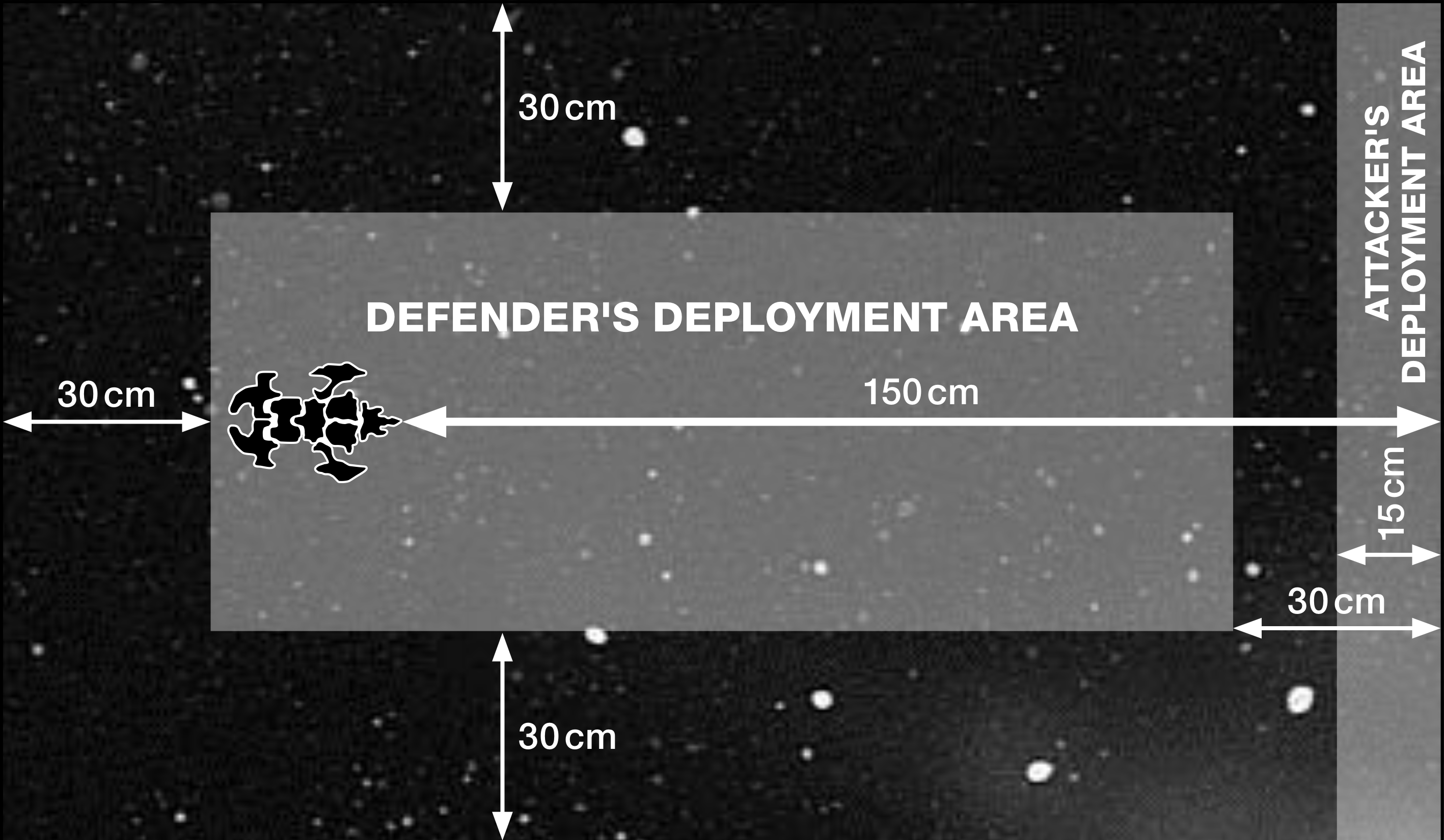
The Craftworld template is placed on the table in the same manner as a planet using the Planetary assault rules on [???] p.76 of the Rulebook. The defender can choose to place ships and squadrons either on patrol or on standby in high orbit, or within the craftworld’s gravity (low orbit table). Roll a D6 for each defending ship/ squadron (except Shadowhunters) on patrol: on a 1-3 the attacker may set up the ship/squadron, on a 4-6 the defender may set it up.
Ships on patrol may be set up anywhere that is not within 30cm of a table edge or within an area of celestial phenomena. The defender always decides the facing of ships, regardless of who set them up. The attacker deploys his fleet within 15cm of the short table edge furthest from the planet. You will also need a separate low orbit table.
Shadowhunter Patrols
Shadowhunters are quite simply the most nimble patrol vessels in the galaxy, and so must always be set-up on patrol, but no dice roll is required, and they are always deployed by the defender.
The Craftworld
In this scenario, the craftworld is considered to be the target of an attack, in the same manner as a planet would be in a planetary assault. The Tyranid assault of Hive Fleet Kraken targetted Iyanden, which is a very large craftworld (about 25cm in diameter). However, if you are refighting this scenario with another craftworld as the target, or if you want to introduce some degree of randomness into the game, you can always vary the size of the craftworld, or roll on a dice: 1 = small (no more than 15cm) , 2-5 = medium (no more than 20cm, 6 = large (no more than 30cm). Craftworlds follow all the rules for planets, since their immense size means they create their own gravity wells, etc. However, they do not roll for moons, rings, etc.
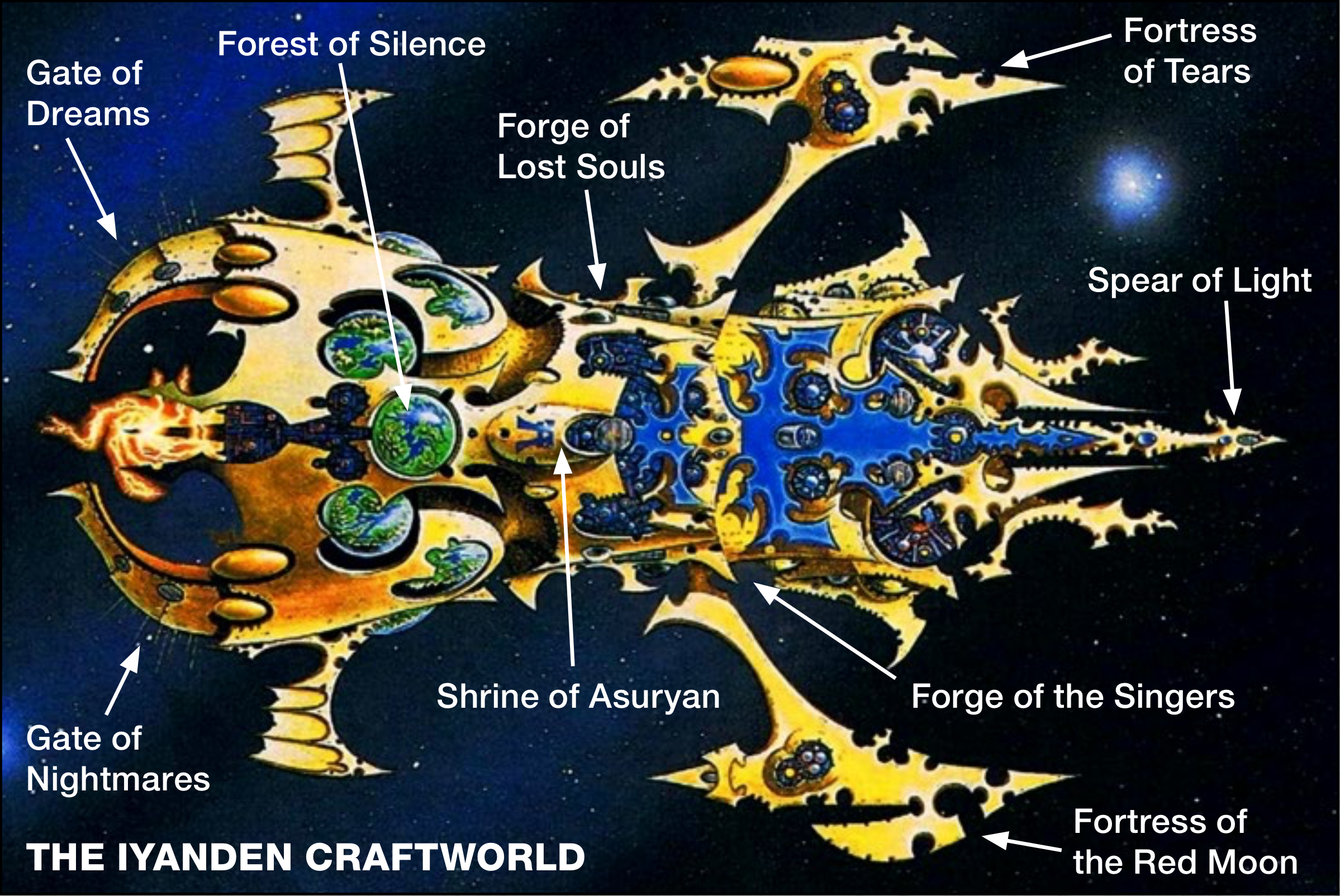
Small craftworlds have a gravity well of 10cm, medium craftworlds of 15cm and large craftworlds of 20cm. The craftworld is placed no more than 150cm from one of the short table edges. Whilst craftworlds do actually travel through space, their progress is so remarkably slow that during the course of a battle they will exhibit no noticeable movement, and hence the template representing the Craftworld itself does not move, in just the same way as planets do not move during a battle, despite their actual movement in orbit of the nearest star. Instead of planetary defenses in the normal sense, individual areas of the Craftworld are purpose-constructed to provide for its collective defense. In the particular case of Iyanden, these roles are fulfilled by three areas – the Spear of Light, the Fortress of Tears, and the Fortress of the Red Moon. Whilst other craftworlds may vary in their defenses, you can safely use the following rules as standard for all craftworlds.
Fortress of Tears & Fortress of the Red Moon
Both these fortresses are designed to repel invaders from Iyanden, utilizing powerful but indirect plasma shots to disrupt and scatter any enemy which manage to evade the craftworld’s cruiser patrols. At full effect the fortresses are designed to act as the defences for the end the entire eastern and western halves of the craftworld respectively. Each time an Assault Point is scored (or ‘landed’ on the Craftworld), roll a dice. On a score of a 4 or more, one of the fortresses damages the attacking wave so heavily that the landing is essentially ineffective and no Assault Point is scored.
The fortresses also allow the craftworld to repel ships in low orbit. During the Eldar player’s Shooting phase, the two fortresses each unleash one 45cm pulsar lance against each escort squadron or capital ship on the Low Orbit table. These cannot be redirected or “stacked” on a single or group of targets; each enemy escort squadron or capital ship can receive no more than two pulsar lance shots that roll to hit in the normal manner pulsar lances are used.
There is always the danger that the fortresses themselves will fall. During each End phase, roll one dice for each Assault Point already scored on the craftworld. If any of these score a ‘6’ one of the fortresses are damaged, and the chance of destroying enemy Assault Points, or scoring a hit on ships in low orbit, is reduced by 1 (ie, to a 5+ the first time, then to a 6+, then they are destroyed completely). No matter how many 6’s are rolled, only a single –1 reduction can apply in each End phase, meaning only a single Fortress can be affected by a single -1 reduction each end phase. When a Fortress is destroyed completely, it can no longer fire upon enemy vessels in low orbit. The number of pulsar lances fired at each enemy ship in low orbit is reduced by 1 for every Fortress destroyed.
Spear of Light
While the Spear of Light is essentially another heavily armed redoubt constructed for the defence of the entire Craftworld, it is most renowned for the Spear of Light, a titanic linear accelerator bearing its name and capable of hurling plasma charges at nearly the speed of light. Its primary purpose is to eliminate dangerous objects in its path, such as recalcitrant moonlets! However, when the defence of the Craftworld is at stake, it can be re-purposed as a weapon with poor accuracy by Eldar standards but horrifying destructive power. The Spear of Light functions as a single Nova Cannon in all respects. Like the fortresses, one dice must be rolled during each End Phase for each Assault Point already scored on the craftworld. If any of these score a ‘6’ the Spear of Light is damaged, and a Reload Ordnance special order must be passed each time the weapon is used again. If a ‘6’ is rolled again in a subsequent End Phase, the Spear of Light is considered destroyed for the rest of the battle. The Spear of Light is used against targets at range and has no effect against vessels on the Low Orbit table.
Forge of the Singers and Forge of Lost Souls
A craftworld’s Bonesingers have at their disposal the means to construct and service an entire Battlefleet of Eldar vessels. Indeed, their construction and fabrication techniques are so efficient, they can quite literally have at their disposal more starships than there are Eldar crew to man them. While even this prodigious capacity serves little utility in the heat of battle, it can in an emergency aid a vessel in dire straits. Any Eldar capital ship in low orbit can dock with the Craftworld by “landing” on the surface without requiring a leadership check. Unlike when coming in contact with a planet’s surface, the vessel does not count as destroyed by doing so, though it must subsequently remain in place for one full turn. It gains +4D6 to repair critical damage in the End Phase and may regain up to 1Hp damage for every roll of 6 not used to repair critical damage (all critical damage must be repaired before this benefit can be taken). Additionally, it counts as passing a Reload Ordnance special order for free. However, it may not move, shoot or launch ordnance while docked, critical damage that cannot normally be repaired during a battle (such as holofields damaged) still remains damaged, and while docked to the Craftworld the ship counts as defences for purposes of being fired upon using the gunnery table. Holofields work normally against gunnery-based weapons, and the ship benefits from an additional right column shift and may ignore blast markers while docked, as it is inside the sheath of the craftworld’s powerful polarization field.
Gate of Dreams and Gate of Nightmares
Like virtually all craftworlds, Iyanden has a series of webway portals scattered throughout its structure. The two largest of these are the Gate of Dreams and the Gate of Nightmares. Each one of these is capable of opening vast portals sizable enough for even the largest of the Eldar’s war machines. Together, they create a single portal at the rear of the Craftworld large enough for traversing starships. Beginning turn 2, after the Eldar fleet moves roll a D6. On a 5+, D3 capital ships and/or escort squadrons of the owning player’s choice held in reserve at the start of the game now appear along the table edge closest to the Craftworld no more than 30cm away from it. Eldar ships cannot move or shoot in the same turn they appear.
First Turn
The players roll a D6, with each player adding their fleet’s initiative (attack rating) to the roll. Whoever got the highest may take either the first or second turn.
Special Rules
Attacking ships must move within 30cm of the craftworld table edge (which obviously replaces the planet edge) on the low orbit table to send troops to the surface and bombard enemy positions. Remember that since the attackers are most likely Tyranids, you should follow the special scenario considerations for Tyranids, as presented in Armada. However, should you wish to vary the attackers, the following basic rules apply:
For each turn an attacking capital ship spends within 30cm of the craftworld edge, the attacker scores 1 Assault Point. For each turn an attacking transport spends within 30cm of the craftworld edge, the attacker scores 2 Assault Points. A ship deploying troops or bombarding the craftworld may not do anything else that turn.
Game Length
The game lasts until one fleet is destroyed or disengages, or the attacker has scored 10 or more Assault Points.
Victory Conditions
Add up the Assault Points earned by the attacker and add +1 to the total for every 500 Victory Points (rounding down) scored by the attacker for destroying or crippling ships and planetary defenses. Deduct -1 Assault Point for every 500 Victory Points (rounding up) scored by the defender. Look up the adjusted Assault Point total on the table below:
| ASSAULT POINTS | RESULT |
|---|---|
| 0-1 | Defender’s Victory (+1 Renown) The attacking forces achieved almost nothing. The pitiful amount of assaulting troops that reached the craftworld will be quickly annihilated. |
| 2-5 | Defender’s Marginal Win The assaulting forces are prevented from making a substantial landing on the craftworld. Nonetheless, enemy detachments will now have to be hunted down and destroyed. |
| 6-9 | Attacker’s Marginal Win The assault dropped enough troops, etc, to capture a large part of the craftworld’s resources. Ongoing battles for control of the world will rage for months, even years. |
| 10+ | Attacker’s Victory (+1 Renown) The attackers succeeded in sweeping aside the defending forces and staging decisive landings at key points all over the craftworld. Within a few weeks of mopping up, the attackers will have complete control of the craftworld. |
Gothic Sector: Eldar Corsairs Fleet List
Fleet Commander
0-1 Pirate Prince
You may include 1 Pirate Prince in your fleet, who must be assigned to a ship and adds +2 to its Leadership, to a maximum of 10. If the fleet is worth over 750 points a Pirate Prince must be included to lead it.
Pirate Prince (+2 Ld) ................................ 100 pts
You may purchase Fleet Commander re-rolls for your Pirate Prince by paying the cost listed below.
One re-roll ..................................................+25 pts
Two re-rolls ................................................+50 pts
Three re-rolls ...........................................+100 pts
Eldar Hero
Your fleet may be led by an Eldar Hero, in place of its normal fleet commander. Only a fleet led by an Eldar Hero may take reserves from the Craftworld Eldar fleet list.
Eldar Hero (Ld 10) .................................... 100 pts
You may purchase Fleet Commander re-rolls for your Eldar Hero by paying the cost listed below.
One re-roll ..................................................+50 pts
Two re-rolls ................................................+75 pts
Three re-rolls ...........................................+100 pts
Capital Ships
0-12 Cruisers
Eclipse class cruiser (pg. 307)....................... 250 pts
Shadow class cruiser (pg. 308) .................... 210 pts
Escorts
You may include any number of escorts in your fleet in squadrons of 2–6.
Hellebore class frigate (pg. 311) .................... 65 pts
Aconite class frigate (pg. 312) ........................ 55 pts
Hemlock class destroyer (pg. 313) ................. 40 pts
Nightshade class destroyer (pg. 314) ............. 40 pts
Ordnance
Any ship with launch bays may choose to have them launch any mix of Darkstar fighters and Eagle bombers. Ships with torpedo tubes are armed with Eldar torpedoes.
Reserves and Allies
An Eldar Hero must lead the fleet in order to use Craftworld Eldar vessels as reserves. Following this, one Craftworld Eldar Flame of Asuryan, Dragonship or Wraithship may be taken for every three cruisers in the f leet. Craftworld Eldar Shadowhunters may be taken in the same ratio of no more than one for every three escort vessels in the fleet. Corsair Eldar escorts and Shadowhunters may not be in the same squadron. If the Flame of Asuryan is taken, the Eldar Hero must be embarked aboard it.
Later Gothic war: Eldar Corsairs Fleet List
Fleet Commander
0-1 Pirate Prince
You may include 1 Pirate Prince in your fleet, who must be assigned to a ship and adds +2 to its Leadership, to a maximum of 10. If the fleet is worth over 750 points a Pirate Prince must be included to lead it.
Pirate Prince (+2 Ld) ................................ 100 pts
You may purchase Fleet Commander re-rolls for your Pirate Prince by paying the cost listed below.
One re-roll ..................................................+25 pts
Two re-rolls ................................................+50 pts
Three re-rolls ...........................................+100 pts
Eldar Hero
Your fleet may be led by an Eldar Hero, in place of its normal fleet commander. Only a fleet led by an Eldar Hero may take reserves from the Craftworld Eldar fleet list.
Eldar Hero (Ld 10) .................................... 100 pts
You may purchase Fleet Commander re-rolls for your Eldar Hero by paying the cost listed below.
One re-roll ..................................................+50 pts
Two re-rolls ................................................+75 pts
Three re-rolls ...........................................+100 pts
Capital Ships
Battleships
Your fleet may include up to one battleship for every full 1,000 points it contains. Therefore, if you have between 0 to 999 points, you cannot field any battleships, while from 1000 to 1,999 points you can include one, and so on.
Void Stalker class battleship (pg. 306) ........ 380 pts
0-12 Cruisers
Eclipse class cruiser (pg. 307)....................... 250 pts
Shadow class cruiser (pg. 308) .................... 210 pts
Aurora class light cruiser (pg. 309) ............. 140 pts
Solaris class light cruiser (pg. 310) ............. 130 pts
Escorts
You may include any number of escorts in your fleet in squadrons of 2–6.
Hellebore class frigate (pg. 311) .................... 65 pts
Aconite class frigate (pg. 312) ........................ 55 pts
Hemlock class destroyer (pg. 313) ................. 40 pts
Nightshade class destroyer (pg. 314) ............. 40 pts
Ordnance
Any ship with launch bays may choose to have them launch any mix of Darkstar fighters and Eagle bombers. Ships with torpedo tubes are armed with Eldar torpedoes.
Reserves and Allies
An Eldar Hero must lead the fleet in order to use Craftworld Eldar vessels as reserves. Following this, one Craftworld Eldar Flame of Asuryan, Dragonship or Wraithship may be taken for every three cruisers in the fleet. Craftworld Eldar Shadowhunters may be taken in the same ratio of no more than one for every three escort vessels in the fleet. Corsair Eldar escorts and Shadowhunters may not be in the same squadron. If the Flame of Asuryan is taken, the Eldar Hero must be embarked aboard it.
Iyanden Craftworld Fleet
Fleet Commander
0-1 Autarch
You may include one Eldar Autarch in your fleet, who replaces the ship’s Leadership with his own. If the fleet is worth over 750 points, an Autarch must be included to lead it.
Eldar Autarch (Ld 9) .................................. 75 pts
Iyanden Bearer of the Flame (Ld 10) ..... 100 pts
The fleet commander may purchase a re-roll, at the cost listed below:
One re-roll ..................................................+25 pts
Eldar Hero
Your fleet may be led by an Eldar Hero, in place of its normal fleet commander. Only a fleet led by an Eldar Hero may take reserves from the Corsair Eldar fleet list.
Eldar Hero (Ld 10) .................................... 100 pts
You may purchase Fleet Commander re-rolls for your Eldar Hero by paying the cost listed below.
One re-roll ..................................................+50 pts
Two re-rolls ................................................+75 pts
Three re-rolls ...........................................+100 pts
0-3 Farseers
You may include up to three Farseers in your fleet, each of whom must be assigned to a capital ship (including the flagship if desired) and gives the vessel a re-roll which may be used on itself, another capital ship in the same squadron or an escort squadron within 15 cm.
0-3 Farseers ................................................+30 pts
Prince Yriel, Bearer of the Flame, Autarch of Iyanden
Before becoming one of the most feared corsairs in all of the Imperium, he was the Autarch of Iyanden, supreme commander of its war host and battle fleet. Unlike an Exarch, an Autarch is one that has the ability to step away from the Path of the Warrior, seek out other disciplines and assume a leadership role. Despite his considerable martial prowess and tactical acumen, it was along the Path of the Mariner that he found his true calling.
Prince Yriel .................................150 pts
Prince Yriel has at his disposal the very finest weaponry and resources available to the Iyanden Eldar. Treat this character as an Eldar Hero with the following additions as part of his point cost: he is accompanied by the fiercest members of Yriel’s own pirate warband, which count as an Aspect Warrior host. His vessel is equipped with Vampire raiders. He has one re-roll as part of his point cost, but a second or third re-roll can be purchased at +25 points each.
Prince Yriel must be embarked on a Dragonship equipped with launch bays, even if he is leading a Corsair fleet. A fleet led by him has an attack rating of 4, even if it includes Craftworld vessels. He must be embarked aboard the Flame of Asuryan if it is present, in which case his cost is 125 points.
Capital Ships
Dragonships
Your fleet may include up to one Dragonship for every two Wraithships included in the fleet. If your fleet is led by an Autarch, you may include a single Dragonship as his flagship which does not count against this limitation. In order to take the Flame of Asuryan, an Eldar Hero must lead the fleet and be embarked aboard it.
(0-1) Flame of Asuryan (pg. 315) .................. 320 pts
Dragonship (pg. 316) ..................................... 260 pts
Wraithships
Your fleet may include any number of Wraithships.
Wraithship (pg. 317) ...................................... 160 pts
Ghostships
Any capital ship in the fleet may be upgraded to a Ghostship. Such a vessel may not also include a Farseer or Aspect Warrior crew.
Ghostship (pg. 292) ............................................. Free
Aspect Warrior Host
Any capital ship in the fleet may be equipped with Aspect Warriors, serving as the ship’s fighting crew.
Aspect Warrior Host (pg. 290) .....................+20 pts
Escorts
You may include any number of escorts in your fleet in squadrons of 2–6.
Shadowhunter (pg. 318)................................... 40 pts
Ordnance
Any ship with launch bays may choose to have them launch any mix of Nightwing fighters and Phoenix bombers. Ships with torpedo tubes are armed with Eldar torpedoes.
Attack craft carriers may also be equipped with torpedo bombers for +15 points per launch bay, with these functioning the same way as other Eldar torpedoes.
Reserves and Allies
An Eldar Hero must lead the fleet in order to use Corsair Eldar vessels as reserves. Following this, one Corsair Eldar cruiser or light cruiser may be taken for every three Dragonships and / or Wraithships in the fleet. Corsair Eldar escort vessels may be taken in the same ratio of no more than one for every three Shadowhunters in the f leet. These may be organized in squadrons in any mix desired, but Corsair Eldar escorts and Shadowhunters may not be in the same squadron. Up to one Void Stalker may be taken in the fleet as long as the fleet is at least 1000 points and at least three Corsair Eldar cruisers and / or light cruisers are already present in the fleet.