Rogue Traders
This page is a work in progress!
Commander
0-2 Veteran Rogue Traders
A Veteran Rogue Trader may lead each Rogue Trader cruiser in a fleet. If a fleet has more than one Rogue Trader cruiser or also includes more than one squadron of transports, a Veteran Rogue Trader must be assigned to a Rogue Trader cruiser.
Veteran Rogue Trader (Ld 9) .................... 50 pts
A Veteran Rogue Trader gets one re-roll, which may be used for his vessel or an accompanying Rogue Trader escort squadron.
Notes from Nate Montes
Siluria Class Light Cruisers and Havoc Class Frigates are older, outdated ships, and much more commonly seen outside of the Imperial Navy.
If both players agree before the game, these ships can be included in a Rogue Trader fleet, as a cruiser and an escort respectively.
Siluria Class Light Cruiser (pg. 76) ..100 pts
Havoc Class Frigate (pg. 79) ................35 pts
Capital Ships
Any fleet except Necrons or Tyranids may include a single Rogue Trader capital ship. Tau, Demiurg and Imperial fleets may include one Rogue Trader cruiser for every 750 points or part thereof in their fleet. If a second Rogue Trader cruiser is taken, it may be any Rogue Trader cruiser variant listed on the Exploration Fleet List. Rogue Trader cruisers always count against cruiser restrictions in any fleet list that has such restrictions. Heavy transports may not be in squadrons with other transport types.
Rogue Trader Cruiser (pg. 174).................... 185 pts
Dauntless Class Light Cruiser (pg. 75)....... 125 pts
Endeavour Class Light Cruiser (pg. 175).... 110 pts
Heavy Transport (pg. 176) .............................. 40 pts
Escorts
A single squadron of 2-6 Rogue Trader escorts and auxiliary vessels may accompany each Rogue Trader capital ship in a fleet, in any mix desired. Separately, it may also be accompanied by any number of cargo ships of any type (whether or not the scenario requires transports), organized in squadrons of 2-6 ships, but these squadrons can only contain cargo ships and always count against their full cost against the total points in the fleet. Xenos vessels cannot be used in fleets that include Space Marine ships.
Xenos Vessel (pg. 178) ..................................... 50 pts
Recommissioned Escort (pg. 183) ................. 30 pts
Iconoclast Destroyer (pg. 184) ...................... 30 pts
Cargo Vessel (pg. 186) .................................... 20 pts
Auxiliary vessels (pg. 185) .............................. varies
Xenos Allies
Experienced Rogue Traders will develop special relationships with other spacefaring races that have similar trade interests. For every 750 points in the fleet, Rogue Traders may be accompanied by a single Demiurg or Kroot vessel unless the fleet is using auxiliary ships that cannot be allies with the Demiurg or Kroot (such as Space Marines).
Sub-plots
Rogue Traders by nature are far from altruistic. Their presence in a fleet indicates they have something to gain by forming a temporary alliance. Whether their own goals actually benefit their erstwhile comrades is usually debatable. Any game that includes a Rogue Trader cruiser must include a sub-plot from [???] p.82-84 in the Rulebook. This can be imagined as representing the Rogue Trader’s own vested interest. As such, if the owning player fails the sub-plot, the enemy earns victory points as if the Rogue Trader cruiser was crippled (in addition to any renown gained or lost normally). If the Rogue Trader was actually crippled in addition to failing the sub-plot, it counts as if being destroyed. The enemy gains no additional bonus for actually destroying the Rogue Trader cruiser except that for renown purposes that the owning player automatically fails the sub-plot. However, if the Rogue Trader cruiser survives the game (even if crippled) and the owning player succeeds in the sub-plot, the owning player gains +1 renown in addition to any gained normally.
If the Rogue Trader disengages and you complete the sub-plot, the enemy gains no victory points for the Rogue Trader cruiser, regardless of its condition. However, if it disengages and the owning player fails the sub-plot, it counts as being destroyed for purposes of victory points, though it may remain on the owning player’s fleet list if used in a campaign.
The Best Money Can Buy
Rogue Trader capital ships and escorts commonly bear refits of uncertain origin. Even the vessel’s crew are unlikely to be anything as straightforward as regular spacers, since Rogue Traders have a knack for acquiring crowds of followers and hangers-on, and tend to be rather indiscriminate in who they take on to crew their vessels. Their command crews however tend to be deeply seasoned after many years in space, and successful Rogue Traders tend to be as experienced as the most veteran Naval captains. To represent this each Rogue Trader cruiser and escort squadron may roll one random crew skill on [???] in the Remastered Rulebook for +10% point value. In addition, each Rogue Trader vessel may roll randomly against the Xenotech System table below for +15 points per cruiser or +5 points per escort. For an additional +5 points per ship, the player can select the desired technology instead of rolling randomly for it. Auxiliary vessels in a Rogue Trader escort squadron can only use these refits if they are in a squadron that includes at least three Rogue Trader escorts.
| D6 ROLL | XENOTECH SYSTEMS |
|---|---|
| 1 | Long Range Sensors: The vessel adds +1 to its base leadership (max. of Ld 10). |
| 2 | Targeting Matrix: The vessel counts all targets as closing when using the gunnery table within 30cm and ignores right-shift modifiers for shooting greater than 30 cm. |
| 3 | Advanced Shielding: The vessel increases the strength of its shields by +1. |
| 4 | Ship Defense Grid: The vessel increases the strength of its turrets by +1. |
| 5 | Advanced Drive Technology: The vessel adds +5 cm to its speed as well as +1D6 when undergoing [All Ahead Full] special orders. |
| 6 | Gravitic Thrusters: The vessel can double the maximum rate of its normal turn. |
Rogue Trader Exploration Fleet List
Using the Exploration Fleet List
Attack Rating
When used with this fleet list, Rogue Traders have an [attack (initiative) rating] of 3.
Xenos Allies
The rules listed on this fleet list take the place of those listed on [???] concerning incorporating Kroot or Demiurg vessels into a fleet accompanied by a Rogue Trader cruiser.
Sub-plots
A Rogue Trader fleet more often than not operates in wilderness space far from support or assistance should the need arise. Any game using the Rogue Trader fleet list must include a sub-plot from [???]-[???] of the Remastered Rulebook.
The Best Money Can Buy
The Xenotech Systems refits listed on [???] can only be used by Rogue Trader cruisers and escorts, not by other reserves or allied vessels in the fleet. Over the course of a campaign, Rogue Trader cruisers cannot earn additional refits from the Xenotech list and must use the refit tables listed on [???] of the Remastered Rulebook. Rogue Traders that join the fleet over the course of a campaign may start by taking one refit from the Xenotech list for the appropriate point cost for rolling randomly or selecting it.
Fleet Commander
Veteran Rogue Traders
A Veteran Rogue Trader may be present for every two Rogue Trader cruisers in a fleet. At least one Veteran Rogue Trader must be assigned to a Rogue Trader cruiser in the fleet.
Veteran Rogue Trader (Ld 9) .................... 50 pts
A Veteran Rogue Trader gets one re-roll, which may be used for his vessel or an accompanying Rogue Trader escort squadron.
Capital Ships
Yourfleet may include no more than twelve capital ships, at least half of which must be Rogue Trader Cruisers and/or Endeavour light cruisers, following the basic profile for this ship.
Lunar class cruiser (pg. 69) .......................... 195 pts
Carnage class cruiser (pg. 263) .................... 195 pts
Rogue Trader cruiser (pg. 174)..................... 185 pts
Tyrant class cruiser (pg. 67) ......................... 185 pts
Murder class cruiser (pg. 265)...................... 185 pts
Dauntless class light cruiser (pg. 75) .......... 125 pts
Endeavour class light cruiser (pg. 175) ....... 110 pts
Notes from Nate Montes
Siluria Class Light Cruisers and Havoc Class Frigates are older, outdated ships, and much more commonly seen outside of the Imperial Navy.
If both players agree before the game, these ships can be included in a Rogue Trader fleet, as a cruiser and an escort respectively.
Siluria Class Light Cruiser (pg. 76) ..100 pts
Havoc Class Frigate (pg. 79) ................35 pts
Escorts
A single squadron of 2-6 Rogue Trader escorts, Rogue Trader cargo ships and auxiliary vessels may accompany each Rogue Trader cruiser in a fleet, in any mix desired. Besides Xenos vessels, auxiliary vessels from only one race can be taken in a fleet. Any race can be used to provide auxiliary vessels except Orks, Dark Eldar, Necrons and Tyranids. Xenos vessels cannot be employed if Space Marine escorts are used as auxiliary vessels.
Xenos Vessel (pg. 178) ..................................... 50 pts
Recommissioned Escort (pg. 183) ................ 30 pts
Iconoclast Destroyer (pg. 184)....................... 30 pts
Cargo Vessel (pg. 186)..................................... 20 pts
Auxiliary vessels (pg. 185) .............................. varies
Transports
The fleet must include at least one squadron of escort-sized cargo ships of any type (whether or not the scenario requires transports), in a squadron of 2 to 6 ships. Any number of cargo ships beyond this number may be taken and organized in squadrons that only contain cargo ships. These count their full cost against the total points in the fleet, and regular transports are not free. Heavy transports may also be taken but not in squadrons with other transport types. No more than 1/3 of the fleet’s total transport value can be made up of heavy transports.
Escort Carrier (pg. 501)................................... 60 pts Q-Ship (pg. 502)............................................... 60 pts Heavy Transport (pg. 176) ............................. 40 pts Cargo Vessel (pg. 186) .................................... 20 pts Armed Freighter (pg. 503) .............................. 20 pts Cargo Transport (pg. 83) ............................... 10 pts
Transports taken for the fleet can be used for any scenario that actually requires transports.
Reserves and Allies
Up to one cruiser from any fleet except Orks, Necrons and Tyranids can be taken for every three Rogue Trader cruisers in the fleet. Capital ships taken count against the cruiser limit, they can only be from one fleet and cannot be from a fleet list differing from that used to provide escort squadron auxiliary vessels. If the fleet is large enough that three reserve or allied capital ships are taken, a single (0-1) allied battleship may also accompany the fleet for its regular point cost without counting against cruiser limits. Reserves and Allied vessels do not have access to the Veteran Rogue Trader re-rolls, but allied vessels may purchase up to one special character from its own fleet list (if available).
The Demiurg
At least one Demiurg vessel of any class may be taken for every three Rogue Trader cruisers in the fleet. This is separate from and in addition to any reserve or allied cruisers taken, but each Demiurg vessel taken still counts against the twelve-cruiser limit, and no more than one Stronghold may be taken. Demiurg vessels may not be employed if Space Marines are taken as reserves, allies or escort squadron auxiliary vessels.
Stronghold Commerce Vessel (pg. 468) ..... 350 pts
Bastion Commerce Vessel (pg. 469) ........... 255 pts
Citadel Commerce Vessel (pg. 470) ............ 185 pts
The Kroot
A single Kroot Warsphere may be taken if there are at least three Rogue Trader cruisers in the fleet. This is separate from and in addition to any reserve or allied cruisers taken, and the Kroot Warsphere does not count against the twelve-cruiser limit. A Kroot Warsphere may not be employed if Space Marines are taken as reserves, allies or escort squadron auxiliary vessels.
Kroot Warsphere (pg. 474) ........................... 145 pts
Pirates and Wolf Packs
Using This Fleet List
Pirate fleets make it their business to attack relatively soft targets such as transport convoys, remote space stations or isolated settlements. They will whenever possible avoid fleet actions or any engagement that will result in substantial losses with little material gain. However, large pirate bands with a substantial fleet at their disposal may elect to actually raid larger planetary colonies.
Leadership
A human pirate requires great charisma and leadership ability just trying to keep his or her grip on the bands of criminals, mutineers and other such unsavory characters that make up a pirate fleet. All pirate vessels suffer a -1 leadership modifier, meaning their unmodified starting leadership will be from 5 to 8.
Attack rating
Pirate fleets have an attack or initiative rating of 3.
Pirates in scenarios
When selecting scenarios, Pirates always roll against the Raid table on [???] of the Rulebook. However, if the Pirate fleet is the attacker and has a fleet of 1,500 points or greater, they may elect to play a Planetary Assault on a D6 roll of 6.
Pirates in campaigns
For campaigns, pirate fleets operate from a pirate base as described on [???] of the Rulebook. They have very limited access to formal shipyards and cannot earn refits in the course of a campaign, but they may instead earn crew skills in the manner other fleets earn refits, in addition to earning them normally.
Fleet Commander
0-3 Pirate Captains
A Pirate Captain may be embarked on a cruiser for every 500 points or portion thereof in a fleet. If a pirate fleet has more than 750 points of ships, a Pirate Captain must lead it.
Pirate Captain (+1 Ld) ................................ 50 pts
A Pirate Captain gets one re-roll, and may purchase up to two more re-rolls for +25 points each. He (or she!) must be placed aboard the most expensive vessel in the fleet (or vessels if more than one Captain is present). Pirate Captains may use their re-rolls on any vessel or escort squadron in the fleet, but no individual Pirate Captain may use more than one re-roll per turn.
Capital Ships
Pirate fleets do not ally with any race, as they are only in business for themselves and consider any ship they encounter and can easily defeat a target of value and opportunity. A human pirate fleet may have up to one cruiser for every 500 points of ships in the fleet or portion thereof.
A Pirate Cruiser may consist of a Rogue Trader cruiser or any cruiser from the Imperial or Chaos fleet lists worth 185 points or less. It may also include a single Space Marine strike cruiser! Special variants, refits and Nova Cannons cannot be used. Otherwise there are no restrictions on how many Chaos and/or Imperial cruisers are in a single pirate fleet.
(0-2) Fra’al Battleship (pg. 188) .................... 250 pts
These count as cruisers for fleet building.
Escorts
At least one squadron of 3–6 escort vessels must be included for each cruiser in the fleet, organized in any mix desired. While transports of various types are typically not included in a raiding fleet once they have been plundered, they can be used if desired but are never free. Note: Pirate bands do not have ready access to complex weapon systems. The number of escort vessels that utilize ordnance or lance weaponry may not outnumber those that rely solely on weapon batteries. Xenos vessels of all types don’t count toward this total.
Escort Carrier (pg. 501)................................... 60 pts
Q-Ship (pg. 502)............................................... 60 pts
Xenos Vessel (pg. 178) ..................................... 50 pts
Idolator Raider (pg. 141) ................................. 45 pts
Infidel Raider (pg. 268) ................................... 40 pts
Firestorm Frigate (pg. 77)............................... 40 pts
Sword Frigate (pg. 80) ..................................... 35 pts
Falchion Frigate (pg. 78)................................. 35 pts
Cobra Destroyer (pg. 82) ................................ 30 pts
Recommissioned Escort (pg. 183) ................ 30 pts
Iconoclast Destroyer (pg. 184)....................... 30 pts
Cargo Vessel (pg. 186)..................................... 20 pts
Armed Freighter (pg. 503) .............................. 20 pts
Cargo Transport (pg. 83)................................ 10 pts
Notes from Nate Montes
Siluria Class Light Cruisers and Havoc Class Frigates are older, outdated ships, and much more commonly seen outside of the Imperial Navy.
If both players agree before the game, these ships can be included in a Rogue Trader fleet, as a cruiser and an escort respectively.
Siluria Class Light Cruiser (pg. 76) ..100 pts
Havoc Class Frigate (pg. 79) ................35 pts
Xenos Freebooters, Corsairs and Brigands
The desire to pillage the riches of others for reasons both obvious and more obscure is not a uniquely human trait. The general confusion and disarray caused by a successful pirate campaign against a given system or group of systems attracts the baser elements of all races, all eager for quick riches, slaves or the more subtle rewards that come from a life of plunder. Up to 10% of a pirate fleet may be made up of alien escorts from any race except Tyranids, Necrons or vessels that require support from a capital ship of their race, such as Nicassar Dhows or Tau Orcas. They can be organized in squadrons of two to six ships, but vessels of different races may not combine with each other into a single squadron, nor can they combine into squadrons with human (Imperial, Chaos or Rogue Trader) vessels. In other words, a squadron of three Eldar escorts and a squadron of three Ork escorts may both be part of the same pirate fleet, but they can only squadron with themselves and NOT with each other or with any Idolators, Swords, etc. The only exception to this is Rogue Trader Xenos Vessels, which represent minor alien races seeking to expand their influence or pursue some other obscure agenda. They may freely ally themselves with any other race and join with them in pirate raider squadrons.
Xenos freebooters and corsairs have no allegiance to the human pirates they serve alongside. They may not use any of a Pirate Captain’s re-rolls, and will automatically attempt to disengage if the escort squadron is crippled (reduced to half their starting number). They are not restricted to nor benefit from the leadership values of human pirates and must use the unmodified leadership from the fleet lists of their respective races.
Rogue Trader Scenarios
In the depths of space, Rogue Traders never know what kinds of threats they will encounter. Additionally, while they may be contracted by an Imperial Commander to escort a given convoy in good faith, as often as not such vessels and their intrepid captains end up being used as fodder to flush out the nature and scope of a given threat in a contested system before the Imperial Navy allocates suitable forces for the task. While this pragmatically husbands the overstretched resources of the Imperial Navy, it brings no profit to the hapless Rogue Trader!
The following threat tables are intended for use as alternatives with the Convoy scenario on [???] in the Remastered Rulebook. If used, the defending player may add up to +50 points worth of ships to whatever point value is allowed in the scenario to defend the convoy for every two normal transports (or their equivalent) taken.
The Cruiser Trap
This table represents a stronger force of attacking capital ships being in the area the convoy is traversing. This table may be used in lieu of any table used to determine the attacking fleet in a convoy run scenario.
| D6 ROLL | RESULT |
|---|---|
| 1 | Two attack craft or deadfall torpedo counters. |
| 2 | Three attack craft or deadfall torpedo counters. |
| 3 | A squadron of escort ships worth up to 150 points. |
| 4 | One capital ship worth up to 185 points. |
| 5 | One capital ship worth up to 210 points. |
| 6 | One capital ship worth up to 250 points. |
Stalkers of the Abyss
History is replete with stories of varying authenticity of daemon ships, void-swimming leviathans and other such malevolent denizens of the warp. Much of it is likely a consequence of the Tyranids’ continuing expansion into the galaxy, as evidence indicates their cruisers will continue to subsist when disconnected from the hive mind. However, a number of sobering reports describe events and circumstances that defy explanation. Some regions of space over the centuries have gained a reputation of being haunted by warp beasts and other mysterious threats, particularly the Bhein-Morr subsector, other regions near the Eye of Terror or Maelstrom, and entire sectors of space near the Northern Rim. Warp beasts always attack the closest defending ship in range, cannot undergo any special orders (including Brace For Impact), and automatically pass all tests they must make against celestial phenomena. Each warp beast (3 to 5) rolled on the below table is worth a flat 100 victory points.
When activated, daemon mine counters are replaced by D3+2 daemon mines, which function as orbital mines in all respects except that they move an extra D6cm each time they move, and they have a 4+ save when attacked by fighters. Each is worth 10 victory points when destroyed for any reason.
| D6 ROLL | RESULT |
|---|---|
| 1 | One daemon mine counter. |
| 2 | Two daemon mine counters. |
| 3 | Warp Beast! A squadron of 2D6 Tyranid drone escorts equipped with feeder tentacles. |
| 4 | Warp Beast! A Tyranid cruiser equipped only with prow massive claws and thorax feeder tentacles. |
| 5 | Warp Beast! A denizen of the warp that is Defence/4, Armour 6+, 2 turrets, 2 shields. It has no weapons and moves 10 cm in any direction per turn, no more or less. When it comes in base contact with any ship, it and the ship immediately disappear! Ships taken count as destroyed. It reappears in D3 turns in the same manner as Chaos daemonships, centring the template where it disappeared. |
| 6 | 6 One Chaos daemonship worth up to 250 points total, including any Chaos Marks. |
The Old Minefield
This table represents a convoy being routed through a gap between old minefields, an obvious place for a clever enemy to lay a trap for passing merchantmen. Orbital mine counters are replaced by D3+2 orbital mines when activated.
| D6 ROLL | RESULT |
|---|---|
| 1 | One orbital mine counter. |
| 2 | Two orbital mine counters. |
| 3 | One orbital mine counter and one attack craft or deadfall torpedo counter. |
| 4 | A squadron of escort ships worth up to 150 points. |
| 5 | A squadron of escort ships worth up to 180 points. |
| 6 | One capital ship worth up to 210 points. |
The Wolf Packs
This table represents an attacking fleet that relies heavily on raiders and other escort warships. This is more representative of the renegade “wolf packs” which preyed on all sides in the Gothic War.
| D6 ROLL | RESULT |
|---|---|
| 1 | One attack craft or deadfall torpedo counter. |
| 2 | Two attack craft or deadfall torpedo counters. |
| 3 | A squadron of escort ships and/or Xenos vessels worth up to 100 points. |
| 4 | A squadron of escort ships and/or Xenos vessels worth up to 150 points. |
| 5 | A squadron of escort ships and/or Xenos vessels worth up to 200 points. |
| 6 | One capital ship worth up to 250 points. |
Scenario One: Merchantmen's Folly
Far from controlled space, a Rogue Trader accompanies a large formation of heady explorers and hastily-contracted merchantmen to a newly-colonized world. Such a ragtag fleet is difficult to keep disciplined and is ripe for the picking by unscrupulous pirates and bandits of every stripe, but they may not be as helpless as they seem…
Forces
Attacking Forces: Attacking forces are randomly generated and set up first. To determine the total strength of the attacking forces, make D3+5 rolls against the table below from the attacker’s fleet list. Alternatively, the attacker may use one of the alternate threat tables on [???]
| D6 ROLL | RESULT |
|---|---|
| 1 | One attack craft or deadfall torpedo counter. |
| 2 | Two attack craft or deadfall torpedo counters. |
| 3 | Three attack craft or deadfall torpedo counters. |
| 4 | A squadron of escort ships worth up to 100 points. |
| 5 | A squadron of escort ships worth up to 150 points. |
| 6 | One capital ship worth up to 200 points. |
Defending Forces: The convoy must include the value of 10 regular transport ships, no more, no less. Up to 100 points worth of ships may be taken to defend the convoy for every two normal transports (or their equivalent) taken, or 150 points if the attacker uses one of the alternate tables on [???] p.83. Before any escorting vessels are taken, at least two each of armed freighters and Q-ships from [???] p.159-160 of Armada as well as two Rogue Trader fast clippers must be included in the fleet, with each pair of armed freighters or fast clippers counting as the value of a single regular transport (rounding down normally). Q-ships follow all their special rules, can be disguised as regular transports if desired and do not have to be revealed until they are fired upon. No more than two heavy transports may be taken, with each costing 40 points and replacing two regular transports. Any of the alternate transport variants listed on the Rogue Traders fleet list or in [???] Armada may be taken, but Q-ships and escort carriers have zero transport value. After all transport variants are selected, any remaining available points may be spent normally on fleet warships to escort the convoy. All transports and civilian vessels must individually roll for leadership, they suffer -1 leadership, and they must roll for special orders and against leadership separately. They cannot be placed into squadrons.
Battlezone
The convoy can be attacked near a planet or out in deep space so set up celestial phenomena in any mutually agreed-upon fashion.
Set-up
Set-up for both the attacking and defending players are in the same manner as described in the Convoy scenario on [???] of the Remastered Rulebook.
First Turn
The defending player takes the first turn in the same manner as described on p.74 of the Battlefleet Gothic Rulebook. The defending player may decide how many ships start the first turn on his or her short table edge, and how many enter on the start of the second turn.
Special Rules
The rules for this scenario are as described on [???] p.74 of the Battlefleet Gothic Rulebook. In addition, at the beginning of each defending player’s turn after the first turn, the defending player rolls 2D6 against the following table. Unless otherwise stated, special orders called for by this table are assumed to have automatically passed and must be taken for that turn.
| 2D6 | RESULT |
|---|---|
| 2 | Two regular transports (or a heavy transport if one is present) have engine trouble and lose 5 cm speed for one turn. |
| 3 | A regular transport has engine trouble and loses 5 cm speed for one turn. |
| 4 | An armed freighter turns normally towards the nearest enemy contact and travels full distance to engage the enemy! |
| 5 | The convoy maintains formation discipline and follows your commands. |
| 6 | An armed freighter and a Q-ship turn normally towards the nearest enemy contact and travel full distance to engage the enemy! |
| 7 | The convoy maintains formation discipline and follows your commands. |
| 8 | Two armed freighters and a Q-ship turn normally towards the nearest enemy contact and travel full distance to engage the enemy! |
| 9 | The convoy maintains formation discipline and follows your commands. |
| 10 | A fast clipper panics, and uses [Comes to new Heading] to turn directly away from the nearest enemy contact and travels full distance. |
| 11 | A fast clipper panics and immediately goes [All Ahead Full]. |
| 12 | PANIC! All transport ships test for [All Ahead Full] special orders, even if some ships fail. Roll leadership checks for each ship separately with no re-rolls allowed. |
Game Length
The battle continues until the last transport leaves the opposite table edge or is destroyed. If a transport leaves one of the long table edges for any reason, it counts as destroyed, though ships that don’t count as transports (such as Q-ships and escort carriers) only count as disengaged.
Victory Conditions
Victory conditions are similar to those described on [???] p.75 of the Battlefleet Gothic Rulebook. However, use instead the table below to determine victory conditions. The point value of each transport that escapes is applied to the defender’s tally when calculating victory points.
| ESCPAING TRANSPORTS | RESULT |
|---|---|
| 0–1 | Attackers Major Victory (+1 Renown) |
| 2–3 | Attackers Victory |
| 4–5 | Convoy Victory |
| 6+ | Convoy Major Victory (+1 Renown) |
Scenario two: The Hunter and The Prey
Sometimes Rogue Traders are contracted by the Imperial Navy or other, less forthright organizations merely for their firepower. Instead of escorting hapless merchantmen and cargo freighters, they are sent out into pirate-infested space to clear the space lanes for legitimate mercantile traffic. While some Rogue Trader captains have enough skill to subsist entirely on this kind of work, it is not uncommon for some to find themselves biting off more than they can chew, and the hunters can quickly become the hunted…
Forces
Choose a point value for the hunting fleet. The raiders choose a value of up to 50% of the hunting fleet.
Hunting Fleet: The hunting fleet may not contain any battleships, and at least half the point value of the hunting fleet must consist of escorts, which can be organized in any mix of between two to six vessels.
Raiding Fleet: The raiding fleet may not contain any battleships, and at least half the point value of the raiding fleet must consist of escorts, which can be organized in any mix of between two to six vessels. This fleet is then split as evenly as possible, labelled Force 1 and Force 2. In addition to the 50% of the hunting fleet available to the raiders, they may purchase up to D6×10 orbital defences from [???] p.141-144 of the Battlefleet Gothic Rulebook.
Battlezone
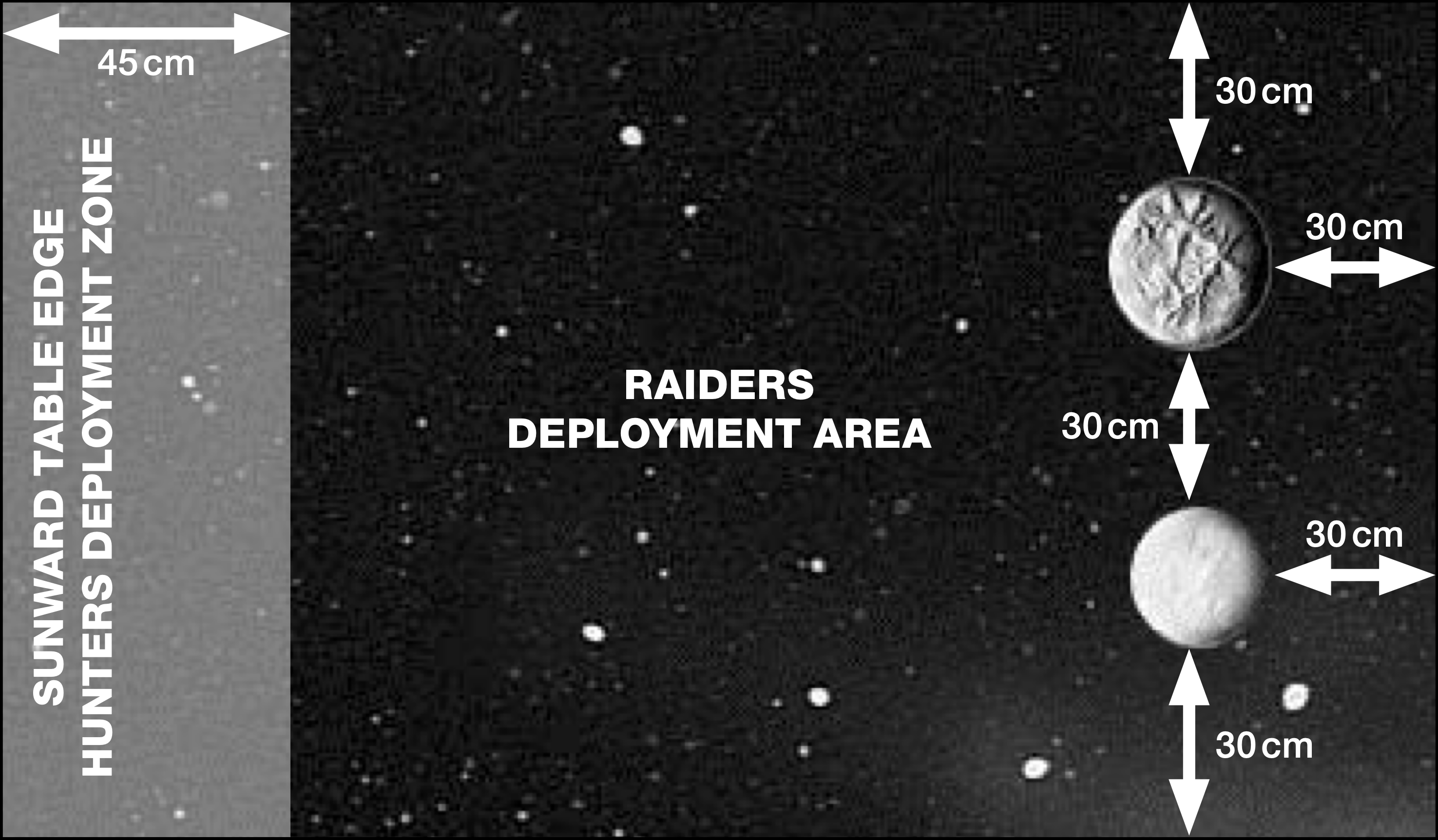
This scenario takes place near a pirate haven in the vicinity of two small planets or moons in close proximity to each other. Randomly determine the sunward edge on one of the two short table edges. Place two small planets closest to the opposite short table edge, no closer than 30 cm to any table edge or to each other. Place D3 asteroid fields on every table quadrant, no closer than 15 cm to either small planet. Additional celestial phenomena may be placed if desired in any mutually agreed-upon fashion.
Set-up
The raiding player sets up first. Roll randomly to determine which of the two forces is on guard. Place a contact marker face down for every cruiser or escort squadron of at least two vessels in the guard force. Counters must be placed at least 30 cm apart and may not be within 45 cm of the sunward table edge. If all of the counters cannot fit on the table, counters may be stacked one on top of the other so that they are otherwise still at least 30 cm apart. The other force is on standby and is docked in low orbit at one of the two small planets – the raiding player secretly notes which one contains the secret pirate base. The raiders orbital defences may be placed anywhere on the table which is not within 45 cm of the sunward table edge. Place a face-down counter to represent each of the raider’s defences. This is not dependent on being 30 cm apart from other markers. The Hunting fleet then sets up and must be deployed within 15 cm of the sunward table edge.
First Turn
The hunting player takes the first turn.
Special Rules
The raiders’ face-down counters are activated by a hunting vessel moving within 30 cm of them. Turn the activated counter face-up immediately as soon as the hunter vessel moves within 30 cm and then completes its movement. Once the hunting player’s movement phase is complete, the raider deploys ships for any counters activated. Any turn after the first turn, the raider may voluntarily activate one counter at the start of its own movement phase, or two counters if the defender is on special orders.
Activated Escort Squadrons: Place one ship from the squadron directly on top of the counter. Place the rest of the ships no closer to the hunters and as close as possible to the first ship (they do not have to be in base contact). They can face in any direction the raider player chooses but must all face the same direction.
Activated Capital Ships & Orbital Defences: Place the ship, defence, minefield (rolling normally for size) on top of the counter facing in any direction the raider player chooses.
Raiders Docked in Low Orbit: Vessels in low orbit are on standby and may not move out of low orbit until they pass a leadership test. This is not a command check such as for special orders, and ships that fail do not prevent others from testing. Units moving out of low orbit cannot take special orders in the same turn except [Brace for Impact].
Game Length
The battle continues for ten turns or until one side’s fleet is destroyed or disengages.
Victory Conditions
Both hunters and raiders score standard victory points for destroying and crippling ships, but the hunter receives no victory points for raider vessels disengaging. However, the hunter earns additional victory points equal to the value of his or her ships that are in low orbit of the raiders’ planet at the end of the game, as they can quickly attack and capture the raider base. The raider scores bonus victory points equal to 10% of the points value of any raider ships that disengage by the end of the game (unless crippled).
Scenario Three: The Gauntlet
In wilderness space, just traversing from one star system to another can be a hazard in and of itself. It is not unheard of for a Rogue Trader cruiser and its attendant fleet to jump out of the warp and back into normal space just to find themselves in the midst of a firefight or at the wrong end of a hostile fleet. In such situations there is not enough time to fleet back into the warp, and Rogue Trader captains must rely on their wits, the skill of their crews and the aim of their guns to see their way through.
Forces
Defending Forces: A single Rogue Trader cruiser and no more than three escorts are selected by the defending player.
Attacking Forces: Forces are selected as desired by the attacking player, but the total point value must not exceed the total value of ships selected by the defender. These forces can only be made up of escort squadrons of at least two ships each. All attacking ships must be divided into at least two units, but can be more if desired.
Battlezone
This scenario takes place out in deep space near a point where ships typically jump into and out of the warp. Use the deep space celestial phenomena generator, ignoring any result that produces a planet.
Set-up
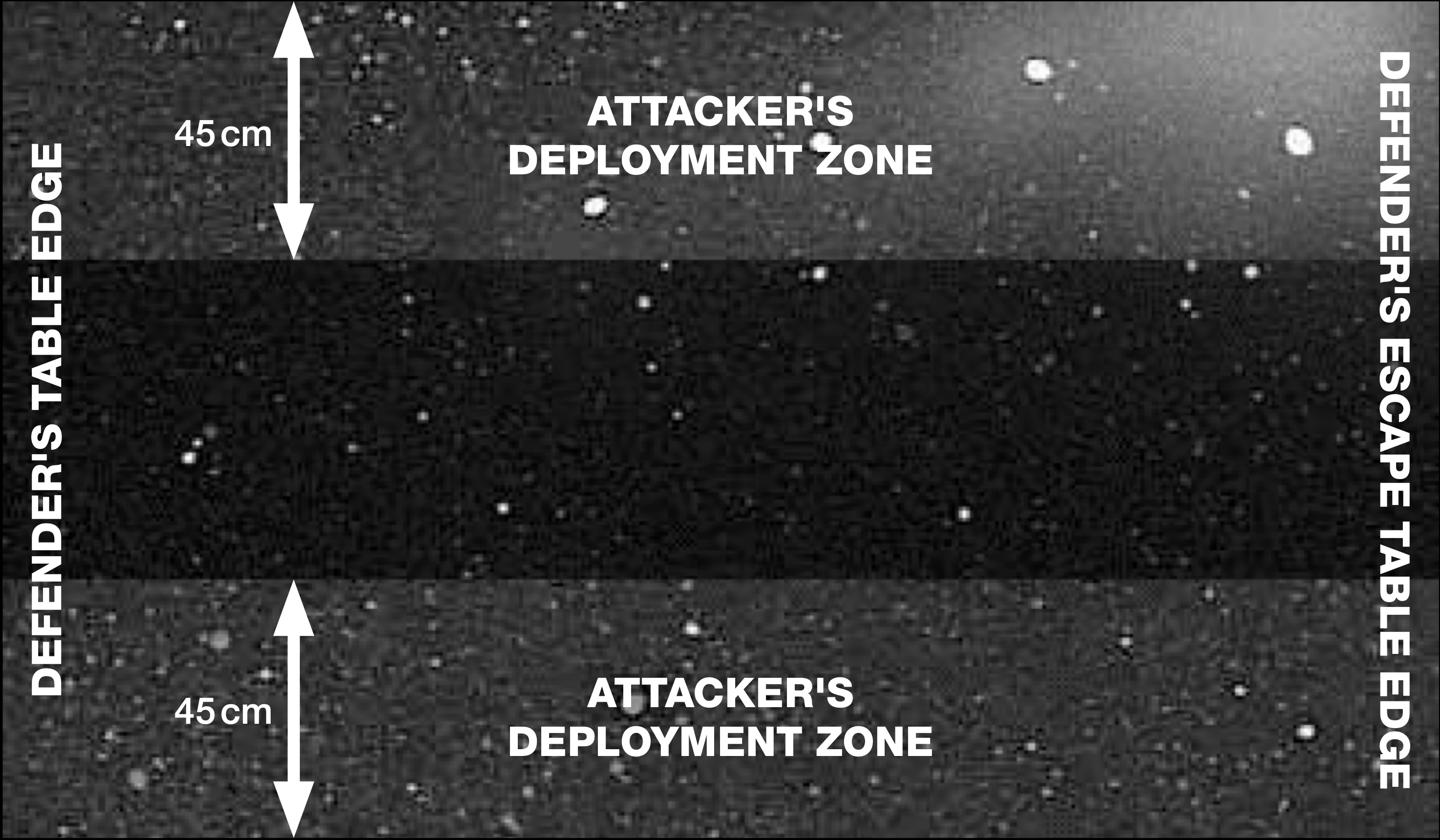
The attacking player divides his or her fleet into two or more units and represents each of them with face-down contact markers, which can be placed anywhere desired within 45 cm of the table edges. When all attacker contact markers are laid down, the defending player rolls a D2 to determine which short table edge it will be entering from, then places his or her ships against one short table edge, no closer than 45 cm from any long table edge.
First Turn
The defending player takes the first turn by moving off the defender’s table edge. All defending units move off the table edge during the first turn.
Special Rules
The attacker’s face-down contact markers are activated by any of the defender’s ships moving within 30 cm of them. Any turn after the first turn, the attacker may voluntarily activate one counter at the start of its own movement phase, or two counters if the defender is on special orders.
Game Length
The battle continues until all of the defender’s ships either escape off the opposite short table edge or are destroyed.
Victory Conditions
Victory points are calculated normally. In addition, the defender earns a major victory (+1 renown) if the cruiser departs the opposite short table edge without being crippled. The attacker earns a major victory (+1 renown) if the cruiser is destroyed.
Note: This scenario is particularly well-suited for experimenting with new homebrew ship designs. If you are wondering what your new ship design and profile is worth in points, send it through the gauntlet and see how it fares, ideally against ships from several different fleet lists! If it handily defeats all arrayed against it, you guessed its point value too low. If it routinely gets destroyed in one or two turns, you guessed too high.
Scenario Four: Explorer's Prize
Every once in a while, a Rogue Trader occasions upon or ascertains the approximate location of a relatively intact starship hulk, either through information dearly traded for, contacts developed through their many travels or just by sheer dumb luck! The Adeptus Mechanicus will pay handsomely for such a prize, particularly if it should be Xenos in origin or possess some manner of archaeotech. Unfortunately, finding it is only the beginning of the problem; Rogue Traders may find they aren’t the only souls seeking out such a valuable treasure, and just capturing and keeping the derelict vessel may result in having a fight on one’s hands!
Forces
Both sides have an equal point value as determined by the applicable fleet list. In addition, there is a derelict ship that at the start of the game does not belong to either player.
Derelict Ship: This ship can be a cruiser-type vessel from any fleet except Necrons or Tyranids agreed upon by both players or rolled for randomly.
Battlezone
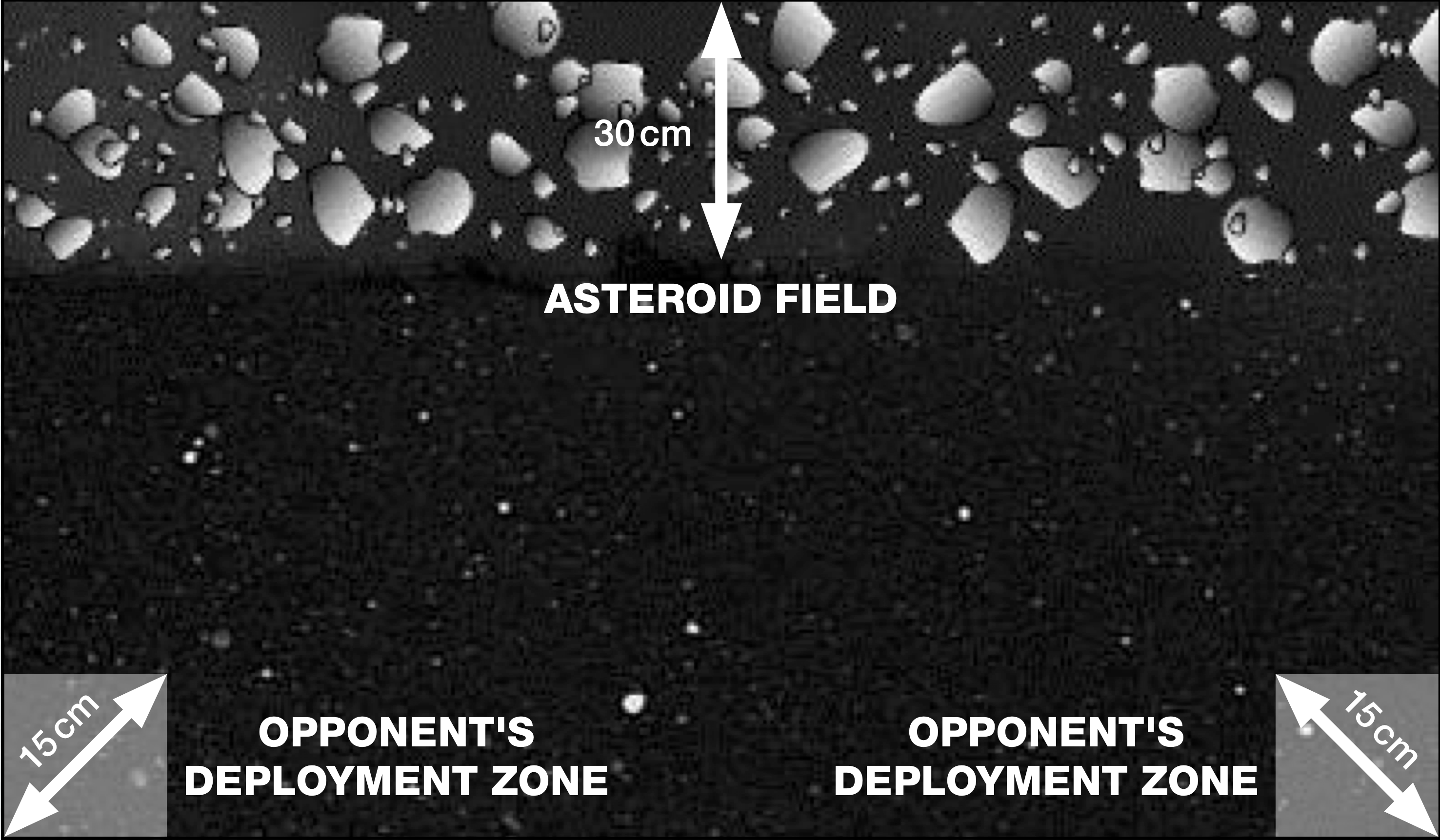
This scenario takes place in the outer reaches. In lieu of generating celestial phenomena normally, determine the sunward edge randomly, then place a single asteroid field no more than 30 cm wide down the full length of one long table edge.
Set-up
Decide by initiative roll which fleet will set up first. Both fleets set up no more than 15 cm from opposing short table corners on the other side of the table from the asteroid field. Additional celestial phenomena may be placed if desired in any mutually agreed-upon fashion, ignoring any result that produces a planet.
First Turn
First turn can be determined by initiative roll normally.
Special Rules
Besides the obvious objective of slugging it out with your opponent, the derelict ship must be located, boarded and escorted off the table. At the beginning of each player’s turn, the player must roll a leadership test normally for any ships in contact with the asteroid field. The owning player rolls a number of D6 for every ship the player had in the asteroid field for one full turn. To this roll add +1D6 for every three attack craft markers (or portion thereof) in the asteroid field for one full turn. On the first roll of 6, the derelict ship is discovered! The owning player may elect which ship actually discovered the derelict, then roll a scatter dice and 3D6. Ignore any “Hit” rolls and place the derelict ship 3D6 away from the ship that discovered it in the direction pointed to on the scatter dice, facing any direction the discovering player desires. Ignore any roll result that sends the derelict ship off the table edge or outside the asteroid field – it will end up no farther than just inside the asteroid field or just before the far table edge.
The first capital ship or escort squadron of at least four vessels that makes base contact with the derelict ship is considered to board it for free. Teleporters and assault boats cannot be used for this initial boarding action because they cannot bring enough of the required crew and equipment aboard. The ship begins with -1 Ld of the highest leadership of what ships or escort squadrons first boarded it, and the boarding ship or escort squadron loses -1 Ld for the amount of crew and officers required for the boarding party. Normal boarding rules apply for any subsequent opposing boarding action, with the derelict ship taking -1 in addition to any other modifiers, though race modifiers for the crew that boarded it apply normally (such as Chaos or Space Marines). The ship begins on standby and must make a leadership test to be activated. Both shields and turrets (or equivalent) are functional, and when it is finally activated it may move normally, but it starts off with one port, starboard, prow and dorsal critical damage (or equivalent). This must be repaired normally before any weapon systems can be used, and it may not use any attack craft even if its launch bays are repaired.
Once the ship is activated, the owning player may immediately begin navigating it out of the asteroid field. Because it is being carefully monitored by both sides, it cannot disengage normally and must make its way to the opposite long table edge to make good its escape!
Game Length
The battle continues until the derelict ship leaves the opposite long table edge or is destroyed.
Victory Conditions
Victory points are calculated normally. In addition, the player that captures the derelict ship and navigates it off the table earns a major victory (+2 renown), even if it is crippled, along with victory points equal to the starting value of the ship. Neither side earns any victory points for the derelict ship if it is destroyed, though its value as a capital ship hulk remains unchanged if one player holds the field at the end of the battle.
Scenario Five: Space Hulk!
Every Rogue Trader dreams of discovering the holy grail of prizes – a space hulk! Riches beyond imagining and all manner of archeotech can be found among the conglomerated wrecks of derelict starship hulls, but the promise of untold wealth comes fraught with many dangers. Many such space hulks are almost inevitably infested with Orks or worse, and only a complete and utter fool would hazard his or her self and ship by exploring such a prize without help – a LOT of help…
Forces
Defending Forces: The defending fleet has a Space Hulk it recently captured and is still in the process of securing. The Space Hulk starts the game with Ld 6, 2D6 hits subtracted from its starting damage (40 HP) and has working turrets and shields, but all weapon systems are off-line. It is being escorted by a Rogue Trader cruiser, an allied battleship, at least three allied cruisers, and escorts in any mix desired. The entire escorting fleet cannot exceed 1200 points (not including the Space Hulk). All escorting capital ships are at -1 Ld for the amount of crew and equipment they have aboard the Hulk.
Attacking Forces: Attacking forces are randomly generated. Do not use the alternate attacker threat tables on p.83 [???] for this scenario. To determine the total strength of the attacking forces, make D3+5 rolls against the table below from the attacker’s fleet list.
| D6 ROLL | RESULT |
|---|---|
| 1 | Three attack craft or deadfall torpedo counters. |
| 2 | A squadron of escort ships worth up to 100 points. |
| 3 | A squadron of escort ships worth up to 150 points. |
| 4 | A squadron of escort ships worth up to 200 points. |
| 5 | One capital ship worth up to 210 points. |
| 6 | One capital ship worth up to 250 points. |
Battlezone
The Space Hulk can be attacked near a planet or out in deep space so set up celestial phenomena in any mutually agreed-upon fashion.
Set-up
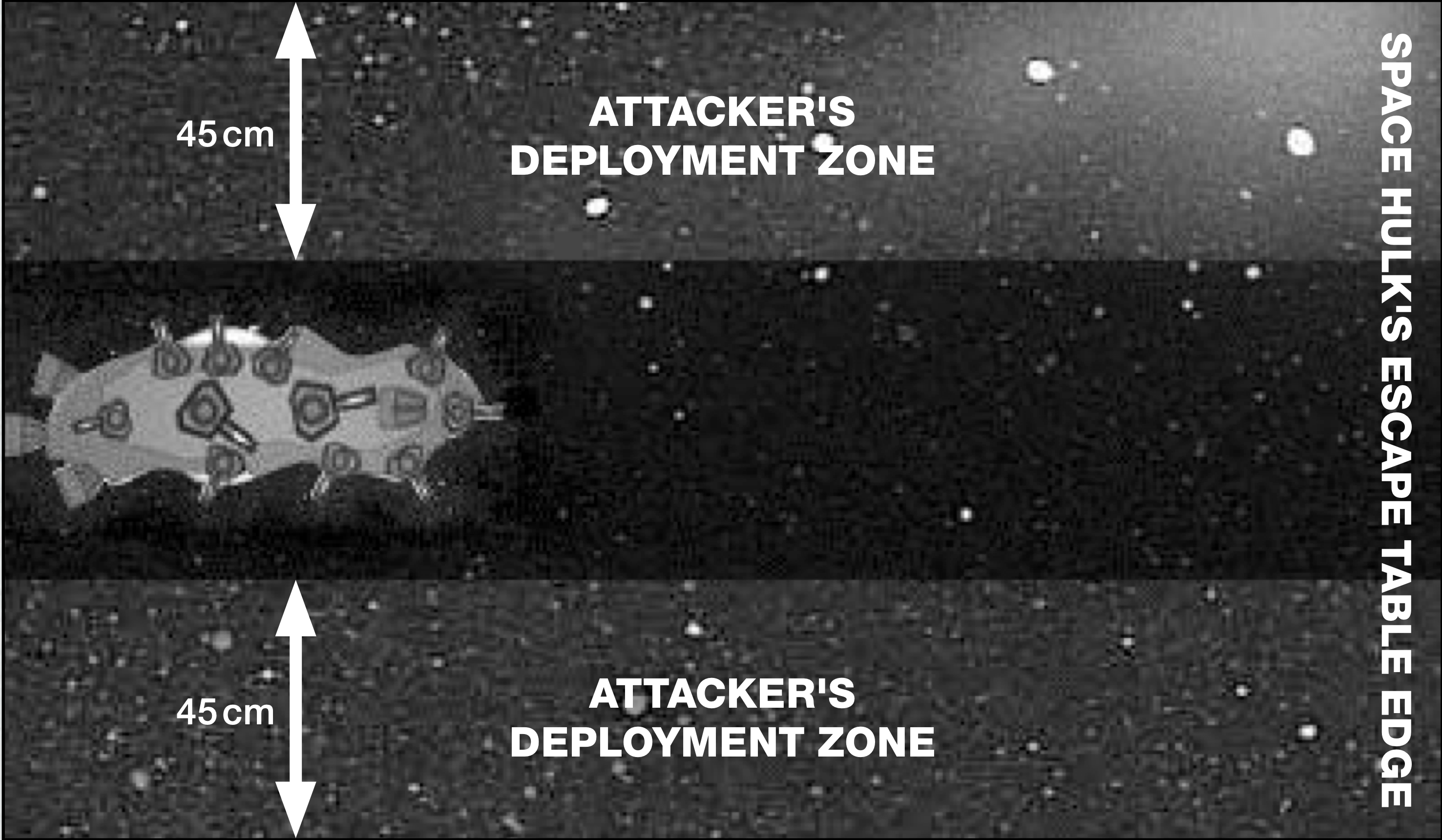
The Space Hulk must be present on the table at the start of the game. Ships of the escorting force may start the game on the table with the Space Hulk or may enter the table at the start of the second turn in any mix and order desired. The attacking player sets up in the same manner as described on p.75 [???] of the Battlefleet Gothic Rulebook.
First Turn
The defending player takes the first turn in the same manner as described on [???] p.74 of the Battlefleet Gothic Rulebook. The defending player may decide how many ships start the first turn on his or her short table edge, and how many enter on the start of the second turn.
Special Rules
The Space Hulk must survive to travel off the opposite table edge. In addition, at the beginning of each defending player’s turn after the first turn, the defending player rolls 2D6 against the following table. The roll result takes effect immediately.
| 2D6 | Result |
|---|---|
| 2 | Chaos! The boarding teams run into a squad of Chaos renegades, and a firefight takes place aboard the Hulk, causing D3 damage. |
| 3 | No effect. |
| 4 | One dorsal lance battery strength is brought on-line (max. 4, then re-roll result). |
| 5 | Three weapons batteries are brought on-line (all four quadrants). |
| 6 | Two torpedo launchers are brought on-line (all three quadrants). |
| 7 | Orks! The boarding teams run into a mob of Orks, and a firefight takes place aboard the Hulk, causing D3 damage. |
| 8 | Two torpedo launchers are brought on-line (all three quadrants). |
| 9 | Three weapons batteries are brought on-line (all four quadrants). |
| 10 | One dorsal lance battery strength is brought on-line (max. 4, then re-roll result). |
| 11 | No effect. |
| 12 | Tyranids! A brood of Genestealers are encountered aboard the Hulk, and that entire section must immediately be cleansed, causing D6 damage. Note how many times this result is rolled. If this result is rolled three times in the game, the Space Hulk is deemed too dangerous to be recovered and must be destroyed! |
Game Length
The battle continues until the Space Hulk leaves the opposite table edge or is destroyed. If the Space Hulk leaves one of the long table edges for any reason, it counts as destroyed.
Victory Conditions
Victory points are calculated normally. In addition, if the Space Hulk is safely navigated off the opposite table edge, the defending player earns a major victory (+1 renown) regardless of how many hits are remaining, along with victory points equal to the starting value of the ship (50% if crippled). If the defender must destroy the Space Hulk, it gains +1 renown for any recovered technology but only gains victory points if the Hulk is destroyed. If the Space Hulk is destroyed for any reason, it is a major victory for the attacker (+1 renown).
Scenario six: The Void Malevolent
Rogue Traders rarely if ever are graced with a Warrant of Trade with the power and authority it bestows based solely on their wealth or social station. More often than not, a Warrant is granted on condition that a critical task or mission be performed, such as escorting a vital convoy through pirate-infested space or cleansing a given system or group of systems of some minor alien menace. However, ancient evils stalk the abyss, against whom all they encounter are little more than prey to be consumed or foes to be destroyed.
Forces
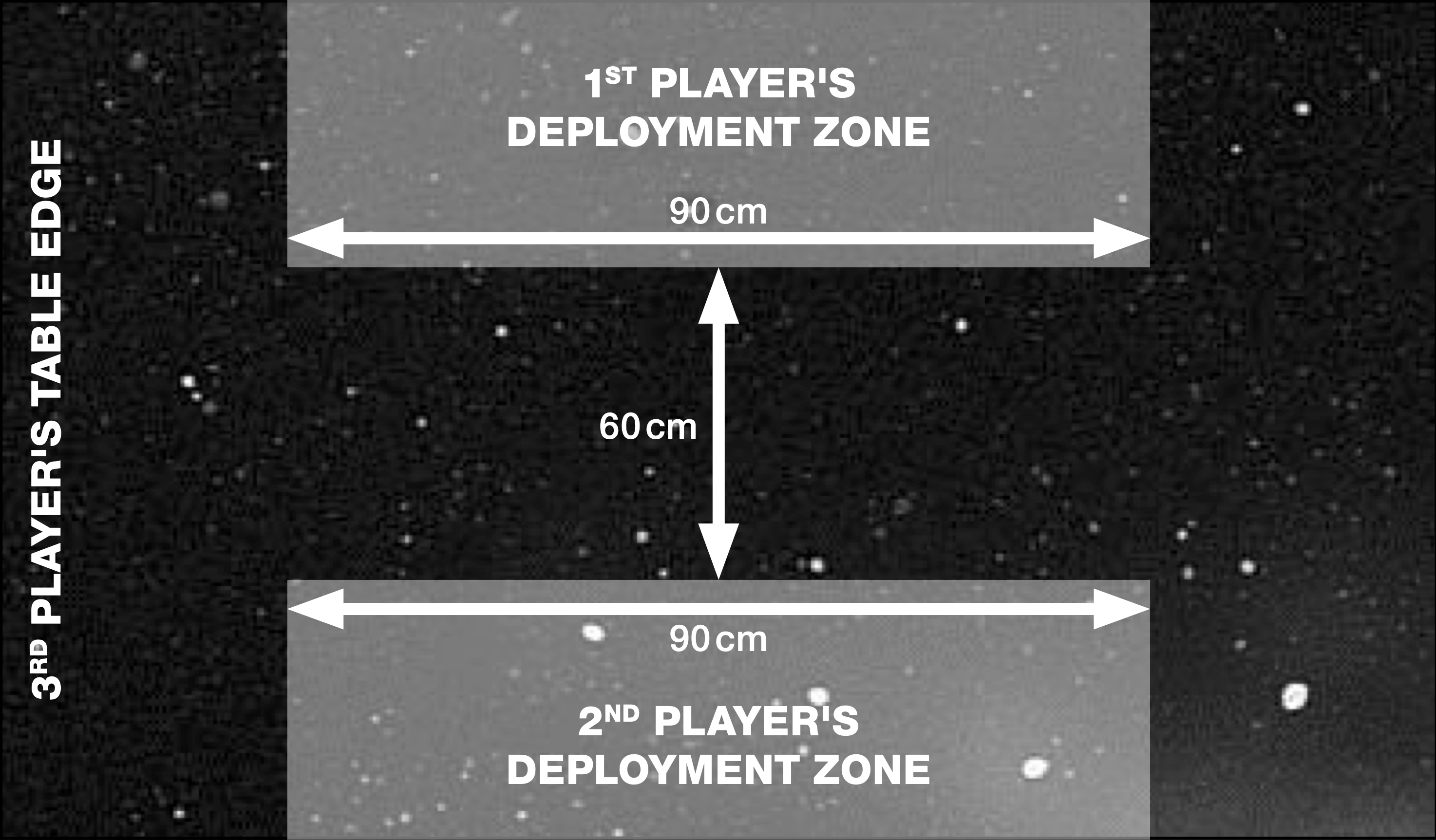
This is a three-player battle. Two sides have an equal point value as determined by their applicable fleet lists. In addition, there is a third fleet that plays the Foe Malevolent.
Foe Malevolent: This fleet is 1.5 times larger than the point value of either one of the two primary opponents. Ideally this fleet would be Dark Eldar, Necrons or Tyranids, but it can be any fleet desired as long as it is played as an enemy of the other two fleets.
Battlezone
The Foe Malevolent may have been hiding in the glare of a nearby sun, in low orbit of a planet or lost in the clutter of swirling asteroid fields. Set up celestial phenomena in any mutually agreed-upon fashion.
Set-up
Both primary fleets set up on opposite long table edges in the same manner as the Cruiser Clash scenario on [???] p.68 of the Battlefleet Gothic Rulebook. The third fleet does not set up for D3 turns. When it does set up, it does so anywhere along a random short table edge.
First Turn
The two primary opponents determine first turn using initiative rolls or any other agreed-upon manner. After D3 turns, game play stops as the third player sets up any desired portion of his or her fleet along the randomly-rolled short table edge. The third player then goes first for the remaining turns of the game (see special rules). Any ships not set up at the beginning of the third player’s turn must enter the game along the same table edge at the beginning of the third player’s next turn.
Special Rules
The third player moves his or her ships in any desired fashion or order as prescribed by its given fleet list. Only the closest enemy ships may be targeted for shooting by the third fleet, though ordnance (if applicable) may target enemy ships in any manner or fashion allowed. With the exception of only shooting the closest targets, all normal and special rules available to the third fleet may be used as applicable.
Because ordnance movement can be complicated by the introduction of a third player, the order of play after the third player sets up is outlined on the following table and continues on in the same order and sequence for all following turns.
| PLAYER | SEQUENCE |
|---|---|
| 3rd Player | Moves ships, conducts shooting, launches ordnance. 2nd Player then moves ordnance a second time. 1st Player ordnance remains in place. |
| 2nd Player | Moves ships, conducts shooting, launches ordnance. 3rd Player then moves ordnance a second time. 2nd Player ordnance remains in place. |
| 1st Player | Moves ships, conducts shooting, launches ordnance. 1st Player then moves ordnance a second time. 3rd Player ordnance remains in place. |
Game Length
The battle continues for eight turns or until all but one fleet disengages or is destroyed.
Victory Conditions
Victory points are calculated normally. Escorts count for victory points individually instead of per squadron. Capital ships count normally. However, their full value in victory points only goes to a player if they reduce a ship from zero damage to zero remaining hits without any assistance from another player. If another opponent causes even one HP damage upon a capital ship, then its victory points must be split equally between the two opponents that caused damage to or helped destroy the capital ship.
Players #1 and #2 determine victory by gaining the most victory points, provided they earn more victory points than they lose before the end of the battle. Player #3 only wins the battle if both other players lose more victory points than they earn.